


Naropa invites you to be courageous—to explore what it means to be truly human—to renew and deepen your connection with the natural world and society; to provoke and sharpen your intellect; to develop your sense perceptions; and to nurture your inherent wisdom and compassion. By engaging scholarship with an unbiased openness to your present experience, you may become fearlessness enough to uplift the world without aggression and allow the gift of your precious human life to have beneficial impact on others.
Program Information
Comprised of six core areas expressed through the petals of a lotus flower, the Core Curriculum invites students to explore the inner resources needed to engage courageously with a complex and challenging world, to help transform that world through skill and compassion, and to attain deeper levels of happiness and meaning in their lives.
Designed to develop both breadth and depth of study, the Core Curriculum will prepare you for deepened scholarship in your chosen major.

These courses explore contemplative and spiritual views and practices that invite students to engage body, mind and heart in cultivating insight, receptivity, and wisdom. Students learn to cultivate openness, curiosity, and compassion, building capacity to skillfully meet complexity and uncertainty. All courses in this area present historical and cultural contexts, key concepts and terminology; honor the range of diverse experiences (physical, cultural, etc.); and emphasize diversity within and across traditions as relevant to the course.
These courses address issues of power, privilege, oppression, and collective liberation. They present concepts and methods that deepen students\' ability to understand and constructively engage with issues at the intersection of race, class, gender, sexuality, and more. These courses include inner and interpersonal practices such as working with emotions and cultivating resilience. They may also include historical analysis and case studies, artistic expression, public scholarship, and opportunities for community engagement and social action. All courses in this area emphasize critical thinking and communication skills.

In these courses, students learn to live in an ecologically just and regenerative relationship with the living earth. They learn to embed principles and practices of sustainability into every aspect of their lives to address local and global environmental crises, to build flourishing communities, and to help foster life-sustaining societies. These courses emphasize critical thinking, writing, and oral presentation skills.

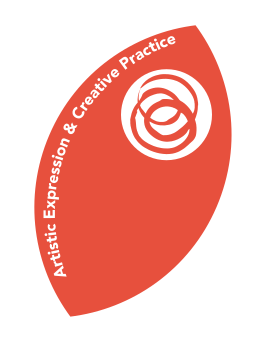
In these courses, students explore creative practices and forms of artistic expression as vehicles for inquiry and communication. Students will discover how art can be a means to awaken perception, conduct embodied research, and develop the possibilities of the imagination toward healing, meaning making, and transformation of themselves, and their communities. Courses in visual arts, writing & poetics, music, dance-movement, and performance engage students in the joys, challenges, and deep learning of the solitary and collective creative process.
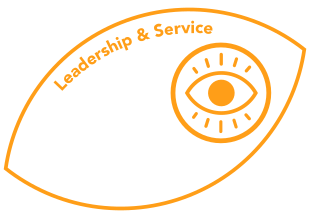
Working with an understanding that leadership takes multiple forms and expressions, courses in this area provide students with opportunities to explore and practice leadership mind-sets and skills. Students develop knowledge and capacities for creative professional and civic life, leveraging their gifts to be of service locally and globally.

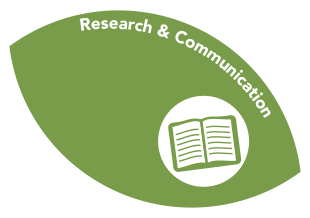
In this area students deepen and sharpen their writing and research skills, weaving their own experience, ideas, social locations, and authentic purpose with broader social, historical, political, artistic, scientific, and cultural contexts. Students learn and practice research methods relevant to their emerging capstone projects, such as finding and evaluating sources, interviewing, and arts-based inquiry. Assignments and instruction address the writing process and writing strategies, providing frequent feedback to support student\' growth and development as scholars and writers.

In this area students deepen and sharpen their writing and research skills, weaving their own experience, ideas, social locations, and authentic purpose with broader social, historical, political, artistic, scientific, and cultural contexts. Students learn and practice research methods relevant to their emerging capstone projects, such as finding and evaluating sources, interviewing, and arts-based inquiry. Assignments and instruction address the writing process and writing strategies, providing frequent feedback to support student’s growth and development as scholars and writers.
Transfer students: Only research-based writing courses will fulfill the Research & Communication requirement. It cannot be fulfilled with any AP or CLEP scores. Students who transfer in the equivalent of a 3-credit research-based writing course will be required to take COR-400 Capstone Design (1-credit online asynchronous course) before COR-440 Capstone II.
The 120-credit Bachelor of Arts degree consists of one or more majors, electives, and a 24-credit core curriculum. Our approach to education nurtures in its students a lifelong joy in learning, a critical intellect, the sense of purpose that accompanies compassionate service to the world, and the openness and equanimity that arise from authentic insight and self-understanding.
Our core curriculum is comprised of an introductory writing seminar, six area requirements (total of 18 credits), and a 3-credit capstone course in which students engage in original research to produce projects that integrate and apply their learning.
Courses in the major provide students with in-depth study in a specific discipline or interdisciplinary course of study, preparing them for graduate and professional schools as well as for meaningful livelihoods and careers.
A Naropa education—reflecting the interplay of discipline and delight—prepares its graduates both to meet the world as it is and to change it for the better.
Naropa College is a collective of faculty and staff dedicated to fostering a vibrant and integrated undergraduate degree experience. Naropa College oversees the Core Curriculum and collaborates with the academic departments and campus partners to support each student on their unique learning journey, from orientation to graduation.
About Naropa
Located in Boulder, Colorado, Naropa University is a Buddhist-inspired, nonsectarian liberal arts university that is recognized as the birthplace of the mindfulness movement. Naropa offers undergraduate and graduate degree programs that emphasize professional and personal growth, intellectual development, and cultivating compassion.
Academics
Contemplative education brings together the best of Western scholarship and Eastern world wisdom traditions. Therefore, your pursuit of wisdom at Naropa means learning both about academic subjects and about your own place in the world. This innovative approach places Naropa on the cutting edge of the newest and most effective methods of teaching and learning.
Admissions & Aid
If you’re seeking an education that resonates with both personal fulfillment and global impact, Naropa could be your top choice. At Naropa, you will experience a comprehensive curriculum that integrates the best of Eastern and Western educational approaches. Explore how Naropa can fuel your journey of intellectual and spiritual development.
Life at Naropa
Through its incredibly vibrant and welcoming community, “Naropa offers a home for those who aren’t willing to conform to convention—the mystic, the healer, the prophet, the rebel, the artist, the revolutionary, the oddball—those who are incredible contributors to the evolution of society and of our planet.”—Core Associate Professor Zvi Ish-Shalom
The Naropa Difference
How is Naropa different from other universities? At Naropa, a liberal arts education balances rigorous academics with powerful interpersonal skills and self-awareness to educate the whole person. Naropa’s contemplative approach is inspired by Buddhist philosophy and the conviction that we can build a diverse, contemplative, enlightened society when we have transformed education to affirm the basic goodness of every person.
Support Naropa
At a time when the value of higher education is being questioned, Naropa University stands firmly rooted in its mission to create a more just and regenerative world by nurturing insight, awareness, courage, and compassion in its students. By making a gift to Naropa, you play a pivotal role in helping to create the authentic, effective & mindful leaders that the world desperately needs.

From Naropa University: Due to adverse weather conditions, all Naropa campuses will be closed on 05/06/26. All classes that require a physical presence on campus will be canceled. Classes that are delivered online in our low-residency programs are to meet as scheduled.
Regardless of Naropa University’s decision, if you ever believe the weather conditions are unsafe, please contact your supervisor and professors.
Graduate School of Counseling concentrations listed below will be offering online and low-residency courses to start their programs in January 2026 as well as our Summer 2026 terms.
Beginning a graduate program in Spring 2026 or Summer 2026 means that you will have access to apply for Graduate Plus loans as these loans will be eliminated at the federal level starting in Fall 2026.
Contact Admissions (admissions@naropa.edu) today to learn how you can begin the next step in your graduate education journey.
Social Justice & Antiracism