

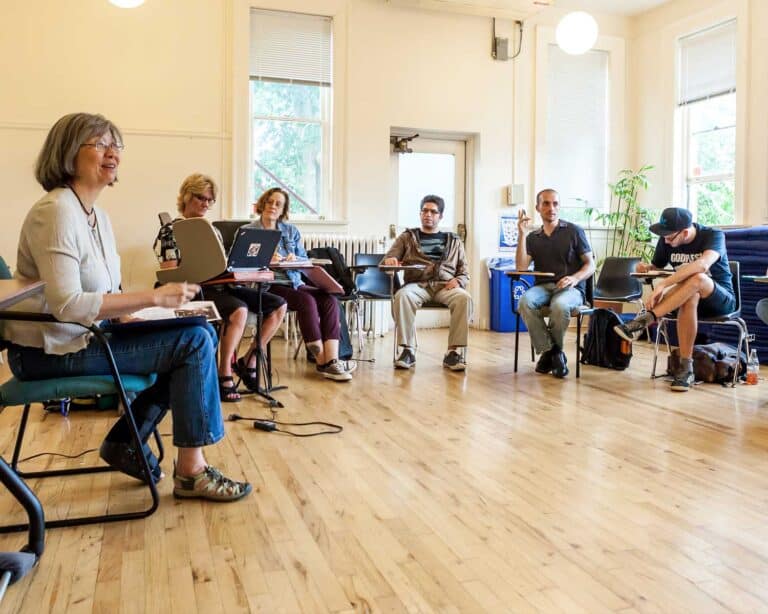
Earn your MDiv degree at Naropa, the West’s first Buddhist-inspired university. Our interreligious spiritual care degree values innovation and social engagement while remaining deeply rooted in contemplative practice.
What is a Master of Divinity? This program uniquely prepares chaplains and spiritual community-builders for lives of contemplative leadership. Our Buddhist-inspired Master of Divinity programs function as an interreligious seminary, welcoming graduate students who represent a diversity of spiritual and religious backgrounds. This three-year accredited program combines deep theological study, community engagement, interreligious spiritual care, and meditation practice, all within a real-world context. Each pathway is grounded in contemplative insights, meditation practices, and clinical training. You may also choose to complete Mindfulness Instructor Training as an optional specialty.
Unlike traditional MDiv degrees, Naropa welcomes students of all faiths and spiritualities, allowing them to pursue their personal divinity journey within an academic setting with hands-on experience opportunities. While the Master of Divinity degree program requires students to engage in contemplative practices, there is no presumption about how the students identify themselves within a specific religious tradition.
Our Master of Divinity degree prepares students through four streams of learning:
Each Master of Divinity student will apply their classroom learning in an ACPE-accredited Clinical Pastoral Education internship. These internships not only provide a context for integrating all four streams of learning and applying them to real-world needs, but also help students integrate study, practice, and service, initiating a lifetime of learning through real-world chaplaincy.


Naropa’s Master of Divinity degree offers two pathways for graduate students. Those who prefer in-person courses can study on our Boulder, Colorado, campus. Graduate students who wish to remain in their current zip code can enroll in our low-residency program. This allows students to do most of their study online, connecting with Naropa faculty and divinity program peers during residential retreats. Each pathway is rooted in contemplative philosophy and practice. Both the on-campus and low-residency degree options share three seven-day residential retreats that bring the students together with their faculty to build community and provide a face-to-face, intensive engagement with contemplative education.

As part of the Master of Divinity programs offered, this course explores the ethics of spiritual caregiving in diverse contexts within the field of professional spiritual care, with a particular focus on empowerment and change agency. Readings and discussions will engage current and abiding ethical considerations such as healthy professional boundaries, the role of chaplains in guiding and supporting ethical deliberation, and complex ethical dilemmas in healthcare such as physician-assisted dying, resource allocation, and end-of-life decision-making.
Naropa’s Master of Divinity degree is a 72-credit, three-year program firmly grounded in Buddhist philosophy and meditation practice, emphasizing an interreligious approach to individual and community care. In addition to in-person retreats, the MDiv program includes a noncredit, seven-day Contemplative Practice Intensive requirement, completed at a retreat center of the student’s choosing. Regular coursework features four meditation practicum courses complementing core Buddhist teachings. Students are paired with personal Meditation Instructors and engage in five hours of meditation weekly.
Subtotal: 6 credits
All courses include a seven-day retreat during the first few weeks of the semester.
Subtotal: 10 credits
Some courses include a seven-day retreat during the first few weeks of the semester.
Subtotal: 10 credits
• REL Electives (6)
Subtotal: 6 credits
Subtotal: 10.5 credits
Some courses include a seven-day retreat during the first few weeks of the semester.
Subtotal: 9.5 credits
Subtotal: 6 credits
Subtotal: 7 credits
Subtotal: 7 credits
All courses include a seven-day retreat during the first few weeks of the semester.
Subtotal: 10 credits
Some courses include a seven-day retreat during the first few weeks of the semester.
Subtotal: 11 credits
Subtotal: 6 credits
Subtotal: 10.5 credits
Some courses include a seven-day retreat during the first few weeks of the semester.
Subtotal: 10.5 credits
Subtotal: 9 credits
Subtotal: 7 credits
Subtotal: 8 credits
Optional Electives or Nitartha Institute Shedra-Gomdra Option, Monthlong Summer Program
Subtotal: 6
All courses include a seven-day retreat during the first few weeks of the semester.
Subtotal: 10
Some courses include a seven-day retreat during the first few weeks of the semester.
Subtotal: 10
REL Electives (6)
Subtotal: 6
Subtotal: 10.5
Some courses include a seven-day retreat during the first few weeks of the semester.
Subtotal: 9.5
Subtotal: 6
Subtotal: 7
Subtotal: 7
All courses include a seven-day retreat during the first few weeks of the semester.
Subtotal: 10
Some courses include a seven-day retreat during the first few weeks of the semester.
Subtotal: 11
Subtotal: 6
Subtotal: 10.5
Some courses include a seven-day retreat during the first few weeks of the semester.
Subtotal: 10.5
Subtotal: 9
Subtotal: 7
Subtotal: 8
Optional Electives or Nitartha Institute Shedra-Gomdra Option only, Monthlong Summer Program

Explore a short, self-paced course with sample classes, teachings from faculty, and real stories from students and alumnx about their experience. Get a feel for how learning happens here through reflection, practice, and real-world application.
Students of Naropa’s Master of Divinity degree may complement their studies with optional specialties that expand students’ skillset, knowledge, and understanding, preparing them for a career of service in their desired field.

Students can choose to allocate 6 credits of electives to attend the month-long Nitartha Institute Residential Summer Program and pursue the Tibetan Tradition specialty. This program presents the systematic foundational courses of the traditional educational system of a Tibetan monastic college (shedra).

Master of Divinity students may also pursue training as mindfulness instructors. Participants develop skills in providing first-time meditation instruction and mentoring for new and ongoing practitioners in diverse contexts. The training consists of a three-weekend online series, plus three 3-hour-long online sessions, which train students to offer instruction in Shamatha (calm abiding) meditation.
Since 1974, Naropa has provided a home for students wanting to study Buddhism and apply Buddhist teachings to meaningful careers. Our Master of Divinity program reflects this commitment, and we’re proud to see so many of our graduates serving their communities as mindfulness educators, sangha leaders, prison and military chaplains, and social justice activists, among other vocations.
Naropa’s contemplative education approach is the cornerstone for all of our graduate and undergraduate programs. In our Master of Divinity program, contemplative education includes not only the practices of a range of religious traditions but also how classes are taught, as well as the seasoned faculty whose lives and careers are steeped in contemplative practice, helping students translate MDiv learning into both rigorous study and lived experience.
Students have the option to choose between two Master of Divinity programs: low-residency or on-campus, as well as a summer start or fall start. We allow students to pursue their divinity degree in the manner and time that suits them best.
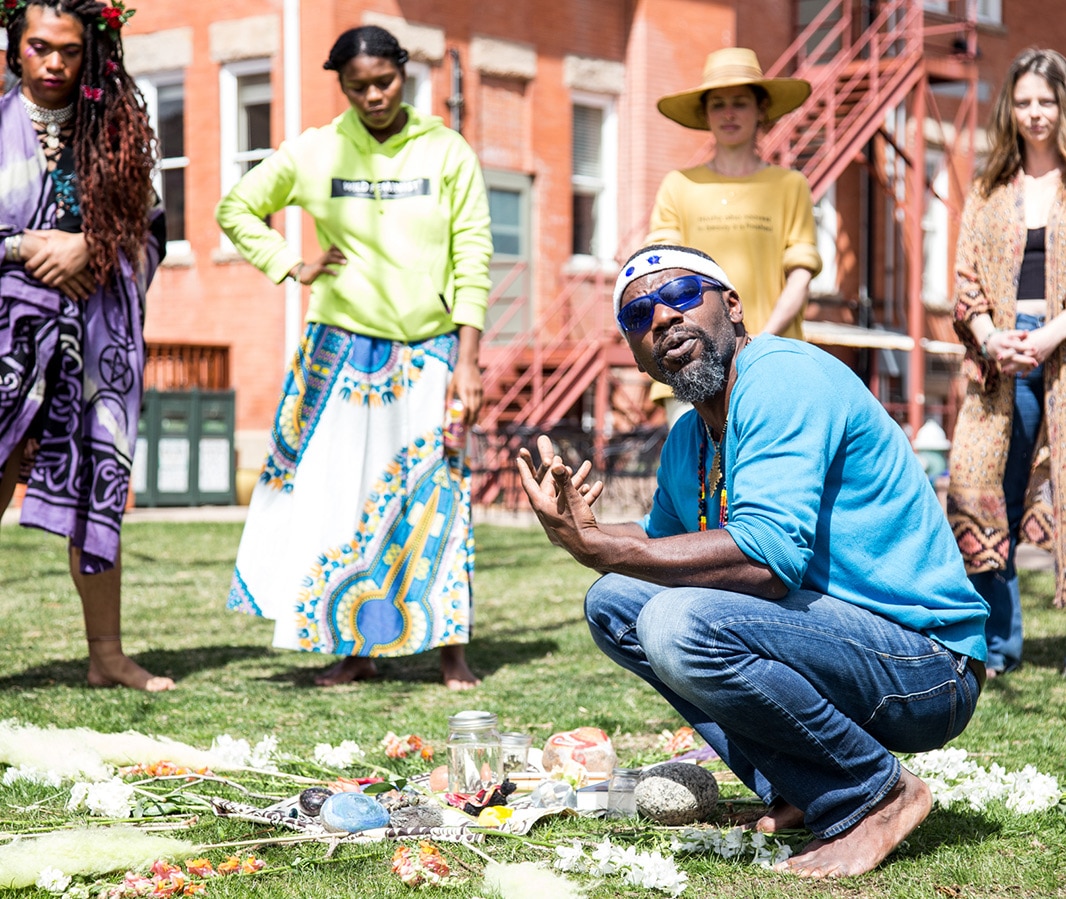
Naropa faculty believe in the value of hands-on learning experiences, especially for service-oriented disciplines. Through Clinical Pastoral Education, students will integrate theoretical learning and apply it to real-world scenarios, beginning their chaplaincy journey.
Students of the Master of Divinity degree receive an academic grounding in the three turnings of Indo-Tibetan Buddhism as well as intensive training in the practice of mindfulness meditation and contemplation. Elective courses allow them to explore other rich contemplative traditions found in Christianity, Judaism, and Islam.
Both low-residency and on-campus Master of Divinity programs encourage students to integrate their academic, experiential, and personal work, culminating in a personalized formative experience. Fieldwork placements are also arranged based on students’ interests. At Naropa, we allow students to reflect on their faiths and beliefs, exploring religion and spirituality at their own pace.
Gain in-depth knowledge of Buddhism and practice interreligious dialogue.
Understand the role of meditative practices in Buddhism and other religions.
Embrace diverse cultures and religions as part of your spiritual path.
Transform from within to be of greater service to others.
Practice a contemplative, interreligious, and inter-spiritual approach to chaplaincy.
Naropa’s Divinity program breaks new ground in preparing Buddhist-inspired students to serve their communities in leadership capacities. With our Master of Divinity degree, graduates can pursue careers caring for the spiritual health of individuals and communities in a variety of clinical environments, from hospitals and hospices to nonprofit and nature-based settings.
 [The Divinity program] opened up my sense of faith and familiarized me with the beauty of different faith traditions, and I learned how to relate to people of different beliefs and how to take accountability for my power and privilege to serve diverse populations.

A Master of Divinity (MDiv) is a graduate-level professional degree focused on preparing individuals for religious leadership, ministry, chaplaincy, and other spiritually grounded careers.
With an MDiv degree, graduates can pursue careers as spiritual and religious leaders, as well as job opportunities in teaching, community service, and healthcare, among other options. Given Naropa’s unique interreligious approach, the scope of opportunities for MDiv Graduates tends to be broader than for graduates of other universities.
The main difference between a Theology and a Divinity Degree is that of intent. Theology is oriented toward philosophical inquiry about God. Theology graduates typically go on to become professors, researchers, and teachers. Divinity is oriented towards service, be it religious and/or spiritual. Divinity graduates may become chaplains, community workers and leaders, activists, counselors, or educators, among other career options.
Naropa offers a Master of Divinity program with an interreligious approach, which is unique in its type. Contemplative education is at the core of our program, affecting both its contents and the way classes are taught. Unlike other divinity programs, Naropa’s MDiv does not require the profession of a specific faith. We allow students to pursue their path to contemplative chaplaincy.
The Center for Contemplative Chaplaincy Buddhist-inspired contemplative spiritual health training to Master of Divinity degree students and members of the larger community interested in pursuing professional chaplaincy and spiritually-integrated approaches to related disciplines. The Center was founded in 2019, and it offers ACPE-accredited Clinical Pastoral Education (CPE) internships in community settings under the supervision of an ACPE-Certified Faculty Educator.
Students meet live for a weekly class, over video-conferencing, and are placed at clinical sites, including hospice, trauma hospital, and community-based settings in their location of residence. A total of 400 hours of training is completed: 300 hours at the clinical site and 100 hours of education.
Several forms of aid are available for students of our Divinity program, including the Frederick P. Lenz Foundation Merit Scholarship. We have multiple scholarships available for graduate students, with different application and/or nomination processes. We also have Financial Aid opportunities available. Please visit our graduate scholarships and financial aid pages to find opportunities.

Admissions Counselor


Admissions Counselor

At Naropa, we value both academic excellence and the willingness to carry out introspective work. Our application process encourages your openness and contemplation. Admission is rolling, and applications will be accepted until the Master of Divinity program is full.
At Naropa, we believe quality education should be accessible. More than 75% of our graduate students receive some form of financial aid to help cover their costs. Our graduate costs & aid page covers costs and financial aid opportunities for graduate students, like scholarships, student employment, and loan options.
Scholarships are a great way to help with the costs of going to school. Naropa University offers an array of scholarship opportunities to graduate students. Students may be eligible to receive scholarships by applying for scholarships or by being nominated for a scholarship. For more detailed information about the different scholarships available and how to receive them, please review our graduate scholarship page.



Magazine
(This article was originally published for Multidisciplinary Association for Psychedelic Studies (MAPS) and has been shortened and reposted with permission. Read the full article here). As more and more people...
Magazine

Magazine

Magazine

Mindful U Podcast 91. Netanel Miles-Yepez: Comparative Religion The newest episode of our podcast, Mindful U, is out on Apple, Spotify, and Stitcher now! We are happy to announce this...

Based on their new book, Skymind: The Radical Path of Open Awareness (Shambhala, 2026), Charlotte Rotterdam and Pieter Oosthuizen will be offering a retreat at Garrison Institute, October 28–31, 2026....

Dr. Judith Simmer-Brown was recruited to serve on an interreligious team of ten people, contracted by the government of United Arab Emirates, to develop a handbook on virtues in six...
Dr. Judith Simmer-Brown—professor emerita at Naropa University and a leading voice in contemplative education and a well-known Buddhist scholar and teacher—was the keynote speaker on the 11th anniversary of the...

The culmination of a four-year collaborative project with Fetzer Institute, Retelling Sacred Stories: Our Journeys to a Shared Sacred Story was published by Orbis Books in 2025. Dr. Judith Simmer-Brown...

Dr. Amelia Hall, core associate professor of Buddhist Studies at Naropa University, is delving into the vivid world where ecology, ritual, and imagination meet. Her recent research focuses on klu—serpentine...
About Naropa
Located in Boulder, Colorado, Naropa University is a Buddhist-inspired, nonsectarian liberal arts university that is recognized as the birthplace of the mindfulness movement. Naropa offers undergraduate and graduate degree programs that emphasize professional and personal growth, intellectual development, and cultivating compassion.
Academics
Contemplative education brings together the best of Western scholarship and Eastern world wisdom traditions. Therefore, your pursuit of wisdom at Naropa means learning both about academic subjects and about your own place in the world. This innovative approach places Naropa on the cutting edge of the newest and most effective methods of teaching and learning.
Admissions & Aid
If you’re seeking an education that resonates with both personal fulfillment and global impact, Naropa could be your top choice. At Naropa, you will experience a comprehensive curriculum that integrates the best of Eastern and Western educational approaches. Explore how Naropa can fuel your journey of intellectual and spiritual development.
Life at Naropa
Through its incredibly vibrant and welcoming community, “Naropa offers a home for those who aren’t willing to conform to convention—the mystic, the healer, the prophet, the rebel, the artist, the revolutionary, the oddball—those who are incredible contributors to the evolution of society and of our planet.”—Core Associate Professor Zvi Ish-Shalom
The Naropa Difference
How is Naropa different from other universities? At Naropa, a liberal arts education balances rigorous academics with powerful interpersonal skills and self-awareness to educate the whole person. Naropa’s contemplative approach is inspired by Buddhist philosophy and the conviction that we can build a diverse, contemplative, enlightened society when we have transformed education to affirm the basic goodness of every person.
Support Naropa
At a time when the value of higher education is being questioned, Naropa University stands firmly rooted in its mission to create a more just and regenerative world by nurturing insight, awareness, courage, and compassion in its students. By making a gift to Naropa, you play a pivotal role in helping to create the authentic, effective & mindful leaders that the world desperately needs.


