
Bachelor of Arts in Sustainability Studies
The world needs more than technical solutions to environmental challenges. It needs leaders who can respond with wisdom, creativity, and a deep sense of connection to the communities and ecosystems they serve. Naropa’s undergraduate Sustainability Studies degree prepares you for that work through an education that connects environmental knowledge with contemplative practice, social responsibility, and meaningful action.
Program Overview
Traditional sustainability education often treats environmental challenges as technical problems to solve. Naropa’s BA in Sustainability Studies recognizes that ecological issues are also social, cultural, political, and deeply personal, requiring leaders who can work across systems and communities with resilience and care.
Through contemplative education, students combine practical study in sustainability with opportunities to explore their relationship with the natural world through reflection, dialogue, and direct experience in nature. Alongside professional skills and environmental knowledge, students develop the self-awareness and sense of purpose needed to discover their own path of service in a rapidly changing world.
Faculty Expertise
- Travis Cox, PhD: Ecopsychology, psychedelics studies, deep sustainability
- Monica Mueller, PhD: Ethics, philosophy, social transformation
- Stephanie Yuhas, PhD (on leave 26–27):
Philosophy, cultural theory, postcolonial studies, ethics, and social change

Quick Facts
- Degree: Bachelor of Arts in Sustainability Studies
- Credits: 33 credits (of 120 credits required)
- Delivery: Residential and Fully-Online Tracks
- Core Themes: Regenerative design, environmental justice, contemplative ecology, and systems thinking.
- Skill Development: Sustainable consulting, energy policy analysis, lifecycle thinking, community-based project management, and restorative leadership.
- Experiential Learning: Applied practice and service learning in local "living laboratories."
- Capstone Experience: A year-long integrated project or action-research study culminating in a public "Social Innovation Showcase."
- Applications Open for 2027

Program Format
The BA in Sustainability Studies moves from building ecological understanding to developing skills in justice, leadership, and professional practice, culminating in a capstone project that integrates reflection with action.
Available in both residential and fully online formats, the program combines collaborative learning, community engagement, and hands-on projects that help students connect environmental knowledge with their own values, communities, and sense of purpose.
Check Out Environmental Studies on Instagram

Here we get to hear from Vanessa some more about her Gaia Theory and Systems class!
#naropauniversity #environmentalstudies #contemplativeeducation #sustainabilityeducation

Here we get to hear from Vanessa some more about her Gaia Theory and Systems class!
#naropauniversity #environmentalstudies #contemplativeeducation #sustainabilityeducation
🌱Over the past two weeks the awesome Permaculture students at Naropa have been working on creating a garden at The Farmstead School. This has included prepping beds and soil, planting some cooler-weather seeds in the ground, compost mulching, and learning about seed families and strategies to best help plants thrive and co-plant correctly.
🍄🟫Additionally, students have been working with our teacher Amy Scanes-Wolfe, to lasagna mulch and prep a grassy area to become a rich and diverse food forest.
The design process is fascinating and inspiring!
🐐This is one of the most hand-on courses offered in our program with direct life-skills coming out of it (you can receive a Permaculture Designer Certificate upon completion of both semesters!)
🪻What do you love about permaculture? And is there anything you’d like to know about this part of our school? Ask in the comments👇🏼
#permaculturedesign #experientiallearning #sustainability #naropauniversity #contemplative
🌱Over the past two weeks the awesome Permaculture students at Naropa have been working on creating a garden at The Farmstead School. This has included prepping beds and soil, planting some cooler-weather seeds in the ground, compost mulching, and learning about seed families and strategies to best help plants thrive and co-plant correctly.
🍄🟫Additionally, students have been working with our teacher Amy Scanes-Wolfe, to lasagna mulch and prep a grassy area to become a rich and diverse food forest.
The design process is fascinating and inspiring!
🐐This is one of the most hand-on courses offered in our program with direct life-skills coming out of it (you can receive a Permaculture Designer Certificate upon completion of both semesters!)
🪻What do you love about permaculture? And is there anything you’d like to know about this part of our school? Ask in the comments👇🏼
#permaculturedesign #experientiallearning #sustainability #naropauniversity #contemplative
Come join Naropa’s tree planting day on April 22nd, 11-1:30pm in Niwot, for Earth Justice Day!
We will be beginning to plant a food forest as part of the ongoing work the permaculture class is doing at The Farmstead School, a unique new Montessori middle school.
Link to sign up in our bio. Feel free to reach out to leeor.glogau@naropa.edu with questions.
#sustainability #earthjustice #treeplanting #permaculture #naropauniversity
Come join Naropa’s tree planting day on April 22nd, 11-1:30pm in Niwot, for Earth Justice Day!
We will be beginning to plant a food forest as part of the ongoing work the permaculture class is doing at The Farmstead School, a unique new Montessori middle school.
Link to sign up in our bio. Feel free to reach out to leeor.glogau@naropa.edu with questions.
#sustainability #earthjustice #treeplanting #permaculture #naropauniversity
Meet Vanessa Tavernetti, one of our amazing faculty members at the ENV program.
#environmentalstudies #naropauniversity #contemplativeeducation #sustainability #alternativeeducation
Meet Vanessa Tavernetti, one of our amazing faculty members at the ENV program.
#environmentalstudies #naropauniversity #contemplativeeducation #sustainability #alternativeeducation
Get to know our courses! (a series)
🌱 ENV-411E: Science of Sustainability 🌱
Curious about sustainability? Here’s what this course is all about:
✨ What to Expect:
Explore the science behind sustainability through ecology, climate science, and systems thinking
Engage in lectures, discussions, workshops, and hands-on activities
Investigate real-world challenges and solutions that affect humans and the more-than-human world
💡 Takeaways:
Strengthen critical thinking, science literacy, and ecological understanding
Learn systems thinking tools to tackle complex environmental issues
Gain strategies to implement nature-based solutions in your community
💦 Experiential Learning:
Conduct water quality labs and data analysis
Design a self-directed sustainability research or action project
Work with case studies and hands-on activities connecting classroom knowledge to real-life impact
What kind of sustainability projects would YOU be excited to explore in your community? Share with us below!
#naropauniversity #environmentalstudies #contemplative #sustainablity #systemsthinking
Get to know our courses! (a series)
🌱 ENV-411E: Science of Sustainability 🌱
Curious about sustainability? Here’s what this course is all about:
✨ What to Expect:
Explore the science behind sustainability through ecology, climate science, and systems thinking
Engage in lectures, discussions, workshops, and hands-on activities
Investigate real-world challenges and solutions that affect humans and the more-than-human world
💡 Takeaways:
Strengthen critical thinking, science literacy, and ecological understanding
Learn systems thinking tools to tackle complex environmental issues
Gain strategies to implement nature-based solutions in your community
💦 Experiential Learning:
Conduct water quality labs and data analysis
Design a self-directed sustainability research or action project
Work with case studies and hands-on activities connecting classroom knowledge to real-life impact
What kind of sustainability projects would YOU be excited to explore in your community? Share with us below!
#naropauniversity #environmentalstudies #contemplative #sustainablity #systemsthinking
What comes up for you when you contemplate the power of stillness and silence in preparation for action?
Thank you @monicaemueller for the reflection and this beautiful shared experience. If you missed it, scroll down to Monica’s previous video to meet our Owl friends.
I’d love to hear from you — when do you call on the power of stillness? Share your reflection in the comments below. ⬇️
#environmentalstudies #naropauniversity #contemplativeeducation #owls #stillness
What comes up for you when you contemplate the power of stillness and silence in preparation for action?
Thank you @monicaemueller for the reflection and this beautiful shared experience. If you missed it, scroll down to Monica’s previous video to meet our Owl friends.
I’d love to hear from you — when do you call on the power of stillness? Share your reflection in the comments below. ⬇️
#environmentalstudies #naropauniversity #contemplativeeducation #owls #stillness
Thank you for sharing, Talon!
It’s truly inspiring to speak with students about their experience at Naropa and in the ENV program. The people who choose our school are unique, grounded change-makers, and we all learn from each other along the way.
What would you want to ask our ENV students? Tell me below 👇🏼
#environmentalstudies #naropauniversity #contemplativeeducation #studentvoices #transformative
Thank you for sharing, Talon!
It’s truly inspiring to speak with students about their experience at Naropa and in the ENV program. The people who choose our school are unique, grounded change-makers, and we all learn from each other along the way.
What would you want to ask our ENV students? Tell me below 👇🏼
#environmentalstudies #naropauniversity #contemplativeeducation #studentvoices #transformative
🌻 Hi Sophie!
Kicking off the semester with some more sweet and inspiring stories from our students. Sophie is a 1st year in the ENV program and a vibrant leader in our community.
Thanks for sharing with us! @sophieroads
🧺 Check out the CSA (community supported agriculture) the Sophie mentioned and is making possible at Naropa
@naropafoodjustice @naropau
#studentleadership #environmentalstudies #naropauniversity #contemplativeeducation #studentvoices
🌻 Hi Sophie!
Kicking off the semester with some more sweet and inspiring stories from our students. Sophie is a 1st year in the ENV program and a vibrant leader in our community.
Thanks for sharing with us! @sophieroads
🧺 Check out the CSA (community supported agriculture) the Sophie mentioned and is making possible at Naropa
@naropafoodjustice @naropau
#studentleadership #environmentalstudies #naropauniversity #contemplativeeducation #studentvoices
We’re baaaaaaaaack! 🌲 (Sing it)
Welcome back, ES students, faculty, and community members! Hope winter break was a treat and you’re feeling inspired and curious for spring semester.
What are you most excited to explore this term? Drop it in the comments 👇
#NaropaUniversity #EnvironmentalStudies #SpringSemester #Sustainability #EcoEducation BackToSchool NaropaCommunity ContemplativeEducation EnvironmentalJustice
We’re baaaaaaaaack! 🌲 (Sing it)
Welcome back, ES students, faculty, and community members! Hope winter break was a treat and you’re feeling inspired and curious for spring semester.
What are you most excited to explore this term? Drop it in the comments 👇
#NaropaUniversity #EnvironmentalStudies #SpringSemester #Sustainability #EcoEducation BackToSchool NaropaCommunity ContemplativeEducation EnvironmentalJustice
Big thanks to Jasper for sharing!
Always love hearing from our awesome ENV students. 💚
#NaropaUniversity #EnvironmentalStudies #StudentVoices #NaropaLife #contemplative
Big thanks to Jasper for sharing!
Always love hearing from our awesome ENV students. 💚
#NaropaUniversity #EnvironmentalStudies #StudentVoices #NaropaLife #contemplative
Hear from Heather, who’s a first year student at Naropa, about her experience in the Nature, the Sacred, and Contemplation course we’ve been sharing about. This is a core course for ENV majors and is a truly transformative experience!
@heatherrllynn
What are some curiosities you have about the course or program based on Heather’s share?
#environmentalstudies #naropauniversity #solo #sacrednature #studentvoices
Hear from Heather, who’s a first year student at Naropa, about her experience in the Nature, the Sacred, and Contemplation course we’ve been sharing about. This is a core course for ENV majors and is a truly transformative experience!
@heatherrllynn
What are some curiosities you have about the course or program based on Heather’s share?
#environmentalstudies #naropauniversity #solo #sacrednature #studentvoices
Hear some student reflections on the Field Ecology course Cat was talking about, they’re powerful 🌎
#environmentalstudies #naropauniversity #fieldecology #studentvoices #biomes #relationship
Hear some student reflections on the Field Ecology course Cat was talking about, they’re powerful 🌎
#environmentalstudies #naropauniversity #fieldecology #studentvoices #biomes #relationship
🌿 Meet Cat, our Field Ecology instructor! 🌍
Each week in this course, students venture into a new biome, learning the stories of the land, the species, and the processes that shape our world. They learn how to read the landscape and build a relationship with the places around them — preparing us all to step into our human role as stewards of the land. 🌱✨
How do you relate to the landscapes around you?
What kind of landscape would you be most excited to explore with us? 🏔️
Share with us! ⬇️
#FieldEcology #NatureExploration #EnvironmentalStewardship #ExploreWithUs #StewardsOfTheLand #EnvironmentalStudies #Naropa #Ecology
🌿 Meet Cat, our Field Ecology instructor! 🌍
Each week in this course, students venture into a new biome, learning the stories of the land, the species, and the processes that shape our world. They learn how to read the landscape and build a relationship with the places around them — preparing us all to step into our human role as stewards of the land. 🌱✨
How do you relate to the landscapes around you?
What kind of landscape would you be most excited to explore with us? 🏔️
Share with us! ⬇️
#FieldEcology #NatureExploration #EnvironmentalStewardship #ExploreWithUs #StewardsOfTheLand #EnvironmentalStudies #Naropa #Ecology
What might Dancing the Biomes be like for me as a student? Stephanie’s here to tell you some more about it, supported by this massive ancient Cottonwood tree 🌳
What comes up for you when you consider engaging in this kind of class?
Any questions?
#environmentalstudies #dancing #embodiedliving #contemplativeeducation #naropauniversity #fyp
What might Dancing the Biomes be like for me as a student? Stephanie’s here to tell you some more about it, supported by this massive ancient Cottonwood tree 🌳
What comes up for you when you consider engaging in this kind of class?
Any questions?
#environmentalstudies #dancing #embodiedliving #contemplativeeducation #naropauniversity #fyp
Dr. Stephanie Gottlob teaches a unique course at Naropa called Dancing the Biomes. This course is a result of her creative exploration of human relationship with nature, which she describes in part here.
Tune into the following videos for more information about what Dancing the Biomes looks like for students, what you’ll take away from this course, and more personal stories from faculty and students.
#environmentalstudies #dance #nature #naropauniversity #ecopsychology #permaculture #fyp
Dr. Stephanie Gottlob teaches a unique course at Naropa called Dancing the Biomes. This course is a result of her creative exploration of human relationship with nature, which she describes in part here.
Tune into the following videos for more information about what Dancing the Biomes looks like for students, what you’ll take away from this course, and more personal stories from faculty and students.
#environmentalstudies #dance #nature #naropauniversity #ecopsychology #permaculture #fyp
Hear from another awesome student in our program - Case Sheppard!
What would you wish to ask our students?
#environmentalstudies #naropauniversity #contemplativeeducation #ecopsychology #permaculture #fyp
Hear from another awesome student in our program - Case Sheppard!
What would you wish to ask our students?
#environmentalstudies #naropauniversity #contemplativeeducation #ecopsychology #permaculture #fyp
Hear from Isaiah, a third year student in the Environmental Studies program here at Naropa.
What would you want to ask him or other students about?
Happy Thursday!
@acia.isaiah
#environmentalstudies #naropauniversity #contemplativeeducation #conservation #traditionalknowledge #student #fyp
Hear from Isaiah, a third year student in the Environmental Studies program here at Naropa.
What would you want to ask him or other students about?
Happy Thursday!
@acia.isaiah
#environmentalstudies #naropauniversity #contemplativeeducation #conservation #traditionalknowledge #student #fyp
Why study our environments?
Hear from Monica Mueller, Chair of Naropa’s Graduate Ecopsychology program and faculty member in the Environmental Studies program.
We had a beautiful, presence-ing moment by the creek.
What draws you to the field of Environmental Studies?
Share with us in the comments!
#environmentalstudies #naropauniversity #contemplativeeducation #ecopsychology #owls #stoke
Why study our environments?
Hear from Monica Mueller, Chair of Naropa’s Graduate Ecopsychology program and faculty member in the Environmental Studies program.
We had a beautiful, presence-ing moment by the creek.
What draws you to the field of Environmental Studies?
Share with us in the comments!
#environmentalstudies #naropauniversity #contemplativeeducation #ecopsychology #owls #stoke
Eco-tourism was the subject of one of our core courses, Nature, the Sacred, and Contemplation on November 7.
Participants (l-r) included Bea Blake, Stephanie Yuhas, Monica Mueller and Jeremy Moore.
#environmentalstudies #ecotourism #naropauniversity
Eco-tourism was the subject of one of our core courses, Nature, the Sacred, and Contemplation on November 7.
Participants (l-r) included Bea Blake, Stephanie Yuhas, Monica Mueller and Jeremy Moore.
#environmentalstudies #ecotourism #naropauniversity
Part 2!
Amy here on what permaculture design is, which you can get certified in by completing both semesters of permaculture courses we offer.
This is not a core requirement of the program but one of the many unique and impactful program elective options you may choose from when you study at Naropa.
Come join us!
Link in bio to learn more about our programs ✨
#permaculture #environmentalstudies #naropauniversity #contemplativeeducation #ecopsychology #permaculturedesign
Part 2!
Amy here on what permaculture design is, which you can get certified in by completing both semesters of permaculture courses we offer.
This is not a core requirement of the program but one of the many unique and impactful program elective options you may choose from when you study at Naropa.
Come join us!
Link in bio to learn more about our programs ✨
#permaculture #environmentalstudies #naropauniversity #contemplativeeducation #ecopsychology #permaculturedesign
Course Spotlight
Food Justice
Explore how food systems, land access, and economic structures shape communities and ecosystems. You’ll examine inequities in the current system while studying community-led approaches to agriculture, food sovereignty, and local economies that support both people and the planet.
Degree
Requirements
A Bachelor of Arts degree (120 credits) consists of a Core Curriculum (24 credits) and at least one major, as well as minors and/or elective courses of the student’s choosing.
The Bachelor of Arts in Sustainability Studies includes 33 credit hours.
Sustainability Studies Online Major
Introductory: 9 credits
- ENV-215E Sustainability (3)
An introduction to the definitions and principles of sustainability, this course explores models and dimensions of sustainability in both the natural world and in human societies. Current examples of sustainable design and development in different parts of the world are offered to inspire students to think sustainably and to be alert to it in every aspect of their learning. Personal impact on the environment and personal sustainability are examined as aspects of developing a sustainable vision for the present and the future. - ENV-370E Environmental Philosophy & Ecopsychology (3)
This course serves as an exploration of the philosophical and psychological dimensions of the human/nature relationship. Deep ecology serves as the primary philosophical framework for this exploration, but other approaches, such as ecofeminism, social ecology, and cutting-edge theories are considered. On the one hand, deep ecology alternatives for addressing ethical and ecological problems are examined, along with options for effective and compassionate action. On the other, a basic tenet of ecopsychology is that personal and planetary well-being are inseparable, so that its theory and practice are directed toward enhancing the health of the human/nature relationship in order to understand, heal, and develop the psychological dimensions of the human/nature relationship through connecting with natural processes in the web of life.
And one of the following:
- ENV-350E Nature, Sacred & Contemplation (3)
An exploration of the individual, cultural, and contemplative dimensions of the human/nature relationship. It provides the contemplative tools of mindfulness meditation, sensory awareness exercises, and other nature-based awareness practices in order for students to examine and refine their own experiences of nature and the sacred. A three-day residential retreat with a solo contemplative nature walk is a required part of the course. - ENV-361E Spiritual Ecology (3)
Concerns about climate change, resource depletion, species extinction, genetic engineering and biodiversity have intensified in recent years. This course will examine the historical and contemporary attitudes and actions of spiritual traditions in responding to the societal impacts of environmental concerns. We will investigate four worldviews in particular: indigenous traditions, Christianity, Judaism and Buddhism, and also consider how these traditions interact with public policy debates and their position on social justice and environmental issues. This course will consider ethical and moral approaches, philosophical principles and social movements to provide tools for dialogue and critical thinking around ecological challenges. This course will also address climate grief and anxiety and introduce ways of working with overwhelm through earth-based practices and eco-therapy.
Sustainability & Ecological Regeneration: Choose 9 credits
Please note: Students who took ENV-350E, Nature, Sacred & Contemplation, for the required may count ENV-361E, Spiritual Ecology, as an elective, and vice versa.
- ENV-207E History of the Environmental Movement (3)
An examination of the history of the environmental movement from a U.S. and global perspective. Fundamental elements that inform and shape environmental movements around the world, and the impact on people and their responses, are studied - ENV-318E Deep Ecology (3)
This course serves as an exploration of the philosophical dimensions of the human/nature relationship. While deep ecology serves as the primary framework for this exploration, other approaches, such as ecofeminism and social ecology, are considered. Deep ecology alternatives for addressing ethical and ecological problems are examined, along with options for effective and compassionate action. - ENV-361E Spiritual Ecology (3)
Concerns about climate change, resource depletion, species extinction, genetic engineering and biodiversity have intensified in recent years. This course will examine the historical and contemporary attitudes and actions of spiritual traditions in responding to the societal impacts of environmental concerns. We will investigate four worldviews in particular: indigenous traditions, Christianity, Judaism and Buddhism, and also consider how these traditions interact with public policy debates and their position on social justice and environmental issues. This course will consider ethical and moral approaches, philosophical principles and social movements to provide tools for dialogue and critical thinking around ecological challenges. This course will also address climate grief and anxiety and introduce ways of working with overwhelm through earth-based practices and eco-therapy. - ENV-415E Ecopsychedelics (3)
This course will explore the current resurgence of psychedelics from Ecopsychological and philosophical lenses. In addition to the traditional Western medical model from which this resurgence tends to view psychedelics, students will learn additional frameworks which will supplement and interrogate the dominant mode, in the hopes of discovering how alternative states of consciousness might be used to build a more just and sustainable society. Also, because of the fast moving and expansive nature of the disciplines of psychedelics at the current moment, students will engage in their own individual and group research projects. - ENV-411E Science of Sustainability (3)
Students will explore the science fundamentals of sustainability via the principles of ecology, climate science and systems thinking especially as they relate to human and other-than-human systems. Through lectures, case studies, and hands-on activities, students will explore the major concepts of Earth as a living system, along with the science behind successful sustainability research, trends and practices. Students will investigate how modern challenges stem from particular worldviews. By the end of the course, students will be able to discern, analyze, and explain the critical components of sustainability science, research, methods and practices, and examine their efficacy. This course will also provide students the opportunity to develop a self-directed research or action project that integrates the key learning strands in the major. The goal of this course is to equip students with the tools and resources needed to assess, encourage and implement sustainability initiatives within their communities and beyond. - SUS-310E Energy Policy (3)
This course asks a single guiding question: what becomes possible for the human and more-than-human world when renewable energy is radically, abundantly cheap? Students begin with energy’s foundational role in physical law—entropy, dissipative structures, and the thermodynamic basis of all economic and ecological order—before turning to the philosophical grounding of human need and flourishing and the emerging science of “decent living standards” as a global, equitable energy floor. From there the course moves into the applied present: the unprecedented collapse in solar costs and rise of energy storage, the policy and land-use battles shaping the transition, the misinformation surrounding it, and the discipline of “energy sobriety” needed to guard abundance against waste. A career-pathways thread runs throughout, with guest speakers and assignments that allow students to explore career paths, alongside group projects exploring how Naropa uses and sources energy. Theory is complemented by hands-on exploration of energy technology. - SUS-320E Global Environmental Challenges (3)
This course investigates the legal, political, scientific, and cultural structures that attempt to address boundary-spanning planetary crises at international, national, regional and local scales. Students survey environmental action along the spectrum from local to global, from the historical Stockholm Conference to the modern Paris Climate Agreement and from municipal green energy efforts to UN Sustainable Development Goals, analyzing how policies at al levels attempt to address crises like climate disruption and rapid biodiversity loss. A core focus of the course is the evolving dialectic which includes science, law, politics, and culture, specifically examining the role they all play in shaping state liability, environmental risk governance, and social change. - SUS-340E Sustainability Consulting (3)
This applied professional course prepares students for sustainability professions, exposing them to the material assessments and carbon-reduction strategies in corporate, public, and non-profit sectors. Utilizing advanced Life-Cycle Assessment (LCA) methodologies, students mathematically map and interpret the ecological footprints of product supply chains from raw extraction to end-of-life disposal. The curriculum introduces more traditional sustainability metrics like circular economy frameworks, training students to evaluate product stewardship practices and closed-loop supply networks, while also familiarizing students with the need to change business-as-usual paradigms both in terms of how organizations are structured and run as well as the role that consciousness plays in determining the mission and values of an institution and how that affects how “sustainability” is conceived. - ENV-350E Nature, Sacred & Contemplation (3)
An exploration of the individual, cultural, and contemplative dimensions of the human/nature relationship. It provides the contemplative tools of mindfulness meditation, sensory awareness exercises, and other nature-based awareness practices in order for students to examine and refine their own experiences of nature and the sacred. A solo contemplative nature walk is a required part of the course.
Environmental Justice & Collective Liberation: Choose 6 credits)
- ENV-253E Solidarity Economies (3)
Democracy, cooperation, environmental sustainability, and social and racial justice are core principles of solidarity economy projects across the world. Tools of conventional and alternative economic analysis are gained, as well as the cultivation of visions of a more just, verdant and peaceful world. Innovative research on solidarity economy projects like cooperative enterprises, community financing, food sovereignty, and many more, provide insight and inspiration to our visions of collective prosperity for all people and the planet. - ENV-257E Food Justice (3)
An introduction to the food justice movement, this course examines it from the local, national, and international levels. Topics include food policy, grassroots movements and action, food production and food access as they relate to the systems of privilege and oppression that shape them. Equally, this course explores the actions of various communities working towards empowerment and liberation. Students engage with relevant theory, hands-on service-learning site visits, as well as contact with professionals, activists, and impacted communities in the food justice movement. - ENV-355E Environmental Justice (3)
An examination of contemporary issues of environmental justice and racism in the United States and throughout the world. The environmental justice movement is based on social justice and multicultural issues. - ENV-363E Indigenous Environmental Issues (3)
An exploration of the historical relationship between indigenous peoples and their environment in each of the ecosystems under consideration; change in the relationship as a result of European contact; modernization and development; and the current integration of these areas into the present global market economy. - PSYB-373E Social Psychology (3)
How do attitudes form and change? How do group dynamics influence decision making? What factors influence altruistic behavior? This course examines concepts and research evidence from areas of social psychology, such as the social self, social influence, cultural variation, attraction, and humanitarian behavior, among others. The underlying variables of mindfulness and arousal are examined as a bridge to the contemplative perspective. - POJS-400E Justice in a Multiracial Society (3)
This course examines how processes of racialization shape, and are shaped by, the state and the criminal justice system. Students will engage with and compare explanatory frameworks from geography, criminology, political economy, and American Studies, as well as insights and analysis from social movements and system-impacted communities. Topics include the origins of the modern prison, the systemic causes of mass incarceration, the rise of the contemporary carceral state, and efforts to reform these systems or create alternative approaches to addressing harm. Students will analyze, compare and apply different theories of the state, race, and social change. The course also considers visions for building a more just, equitable, and life-affirming society. - POJS-303E Environmental Politics (3)
This course examines how humanity’s relationship to the environment is shaped by political forces especially in either enabling or deterring environmental protection and human thriving. Students will critically engage environmental politics at the intersection of three key areas: 1) environmental and climate science; 2) the relationship between diverse cultures and ecosystems; 3) political systems, prevailing political and economic conditions, and geopolitics. - PAX-340E Conflict Transformation: Theory & Practice (3)
An exploration of theories and practices of conflict transformation in a range of settings and locations. The course examines interpersonal and structural dynamics of conflict, building skills to work effectively with individuals and small groups, and studying attempts to end cycles of violence, revenge, and trauma at the national and international level. We investigate our own assumptions about conflict, the potency of cultural and religious differences, the complexities of intervention, and the possibility of transformation. We consider the role of curiosity, creativity, and the moral imagination in peacebuilding. Students in this course write and produce original digital stories and acquire beginning level skills in mediation.
Leadership & Applied Practice: Choose 6 credits
- ENV-250E Restorative Principles & Practice (3)
This course provides an interdisciplinary look at restorative principles and practices, with an emphasis on examining alternative perspectives and approaches to conflict and harm. Students will learn the history, development and types of restorative practices. We will co-create a collaborative learning space where students can engage with questions about conflict and harm as they relate with social justice and learn the structure and skills involved in restorative processes. - ENV-401E Environmental Leadership Skills (3)
Throughout the course students will reflect on and develop their own unique leadership style. Experiential and participatory practice develops skills required for successful environmental leadership in professional, nonprofit, government, community, agriculture/ecological and environmental justice settings. The tool-kit for this course focuses on communication strategies, project management, campaign development, and community organizing across multiple settings. The relationship between contemplative practice and leadership is a recurring theme. - ENV-420E Environmental Service Learning (3)
This course requires students to apply their skills from classroom learning and to engage in hands-on environmental work, while developing their leadership skills and contemplative approaches to environmental action. Students engage in real issues and learn through practical experience about environmental problem solving, community concerns, and teamwork. In this service-learning team project, students engage with community partners in ecological restoration work in our community. Students are responsible for project planning and design, implementation, and final presentation of outcomes to the community partners. - POJS-304E Planning, Organization & Project Management (3)
This course prepares students with the fundamental tools and practices involved in planning, organizing, and project management. The course provides experiential knowledge and skills critical in the fields of social movement organizations (SMOs), non-profit, and government sectors. Planning encompasses a wide swath of topics including personal work plans and campaign plans. Organization examines advocacy, mobilization, and organizing strategies and tactics. Project management provides in-depth instruction on how to manage a project in multi-stakeholder, community and civic based scenarios. This course is predicated on the principle of learning by doing, and students will be working in teams collaborating throughout the semester to practice these skills and principles of strategic planning, effective organizing, and proficient project management. - PSYB-474E Leadership Development (3)
The urgency of racial injustice, the climate crisis, political polarization and growing anger in communities demands that each of us develop the leadership skills needed to make a difference. Navigating complexity in organizations, communities, relationships etc. gives rise to leadership opportunities and challenges and we will use these to both study and practice leadership development. We will bring the theories of Robert Kegan, Jennifer Garvey Berger, Bill Torbert, and others to life through practices such as self-inquiry, exploring polarities, developmental scaffolding, and adult attachment interviews, etc. In other words, this course integrates theory and practice in our lived experience. These theories are not age-based but rather they’re based on growing our capacity to thrive and lead in complexity. - POJS-402E Ethics in Public Service, Justice, and Government (3)
This course examines ethical principles and dilemmas in public service, government, and the pursuit of justice. Students explore theories of moral responsibility, integrity, and accountability as they apply to leadership, policymaking, and the administration of justice. In addition to evaluating systems and decisions, students consider what it means to cultivate the character and virtues necessary to act justly in public life. Case studies highlight issues such as corruption, transparency, equity, and the ethical use of power in democratic institutions. By connecting ethical theory with practice, students gain tools to navigate the complex moral challenges that arise in service to the public good.<
Capstone: 3 credits
Please note: The Capstone is required for all students.
- COR-440E Capstone II (3)
Building on work produced in Capstone I, students implement an original project that reflects substantial research and work, which may include contemplative, community-based, creative, and social innovation components. This product could be a 25-30 page academic paper or its equivalent in creative or community-engaged projects (with a minimum 12-15 page text). The semester ends in celebration and ceremony, featuring student presentations of their work, which may include creative writing, dance-movement, film, music, theater, and visual arts as well as socially innovative curricula, programs and models.
Total Credits: 33
Sustainability Studies Residential Major
Introductory: 9 credits
- ENV-215 Sustainability (3)
An introduction to the definitions and principles of sustainability, this course explores models and dimensions of sustainability in both the natural world and in human societies. Current examples of sustainable design and development in different parts of the world are offered to inspire students to think sustainably and to be alert to it in every aspect of their learning. Personal impact on the environment and personal sustainability are examined as aspects of developing a sustainable vision for the present and the future. - ENV-370 Environmental Philosophy & Ecopsychology (3)
This course serves as an exploration of the philosophical and psychological dimensions of the human/nature relationship. Deep ecology serves as the primary philosophical framework for this exploration, but other approaches, such as ecofeminism, social ecology, and cutting-edge theories are considered. On the one hand, deep ecology alternatives for addressing ethical and ecological problems are examined, along with options for effective and compassionate action. On the other, a basic tenet of ecopsychology is that personal and planetary well-being are inseparable, so that its theory and practice are directed toward enhancing the health of the human/nature relationship in order to understand, heal, and develop the psychological dimensions of the human/nature relationship through connecting with natural processes in the web of life.
And one of the following:
- ENV-350 Nature, Sacred & Contemplation (3)
An exploration of the individual, cultural, and contemplative dimensions of the human/nature relationship. It provides the contemplative tools of mindfulness meditation, sensory awareness exercises, and other nature-based awareness practices in order for students to examine and refine their own experiences of nature and the sacred. A three-day residential retreat with a solo contemplative nature walk is a required part of the course. - ENV-361 Spiritual Ecology (3)
Concerns about climate change, resource depletion, species extinction, genetic engineering and biodiversity have intensified in recent years. This course will examine the historical and contemporary attitudes and actions of spiritual traditions in responding to the societal impacts of environmental concerns. We will investigate four worldviews in particular: indigenous traditions, Christianity, Judaism and Buddhism, and also consider how these traditions interact with public policy debates and their position on social justice and environmental issues. This course will consider ethical and moral approaches, philosophical principles and social movements to provide tools for dialogue and critical thinking around ecological challenges. This course will also address climate grief and anxiety and introduce ways of working with overwhelm through earth-based practices and eco-therapy.
Sustainability & Ecological Regeneration: Choose 9 credits
Please note: Students who took ENV-350, Nature, Sacred & Contemplation, for the required may count ENV-361, Spiritual Ecology, as an elective, and vice versa.
- ENV-100 Earth Systems, Cosmology & Gaia (3)
Deepening our natural understanding of the earth as a living system, this course explores Gaia Theory and the new cosmology of the earth that is emerging in science. Within this framework, we explore the formation of the earth—geomorphology and geophysiology—or one could say the digestion, circulatory, and other systems of Gaia. This new vision in Western science can reawaken understanding and reconfirm our commitment and reciprocity with the earth. - ENV-207 History of the Environmental Movement (3)
An examination of the history of the environmental movement from a U.S. and global perspective. Fundamental elements that inform and shape environmental movements around the world, and the impact on people and their responses, are studied. - ENV-260 Introduction to Permaculture (3)
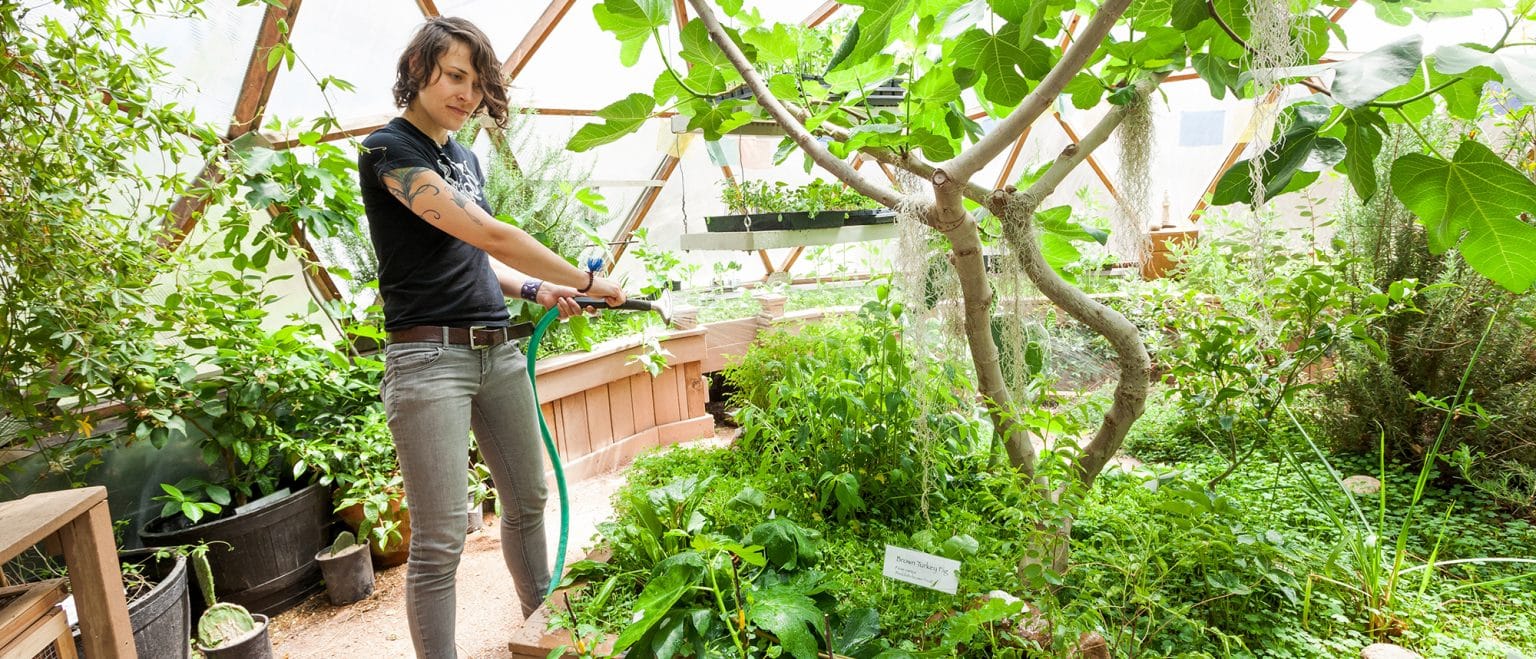
This course introduces a core set of principles that help us to design human living environments that are increasingly self-sufficient, while reducing our society’s reliance on industrial systems of production and distribution that are fundamentally damaging to the planet’s ecosystems. This design system, known as permaculture, covers basic agro-ecological design theory. We explore this in a hands-on way while creating edible landscapes, diverse gardens, and compost systems, and growing food on campus. This course also includes field trips and demonstrations. - ENV-318 Deep Ecology (3)
This course serves as an exploration of the philosophical dimensions of the human/nature relationship. While deep ecology serves as the primary framework for this exploration, other approaches, such as ecofeminism and social ecology, are considered. Deep ecology alternatives for addressing ethical and ecological problems are examined, along with options for effective and compassionate action. - ENV-342 Permaculture Design (3)
Advanced coverage of the Permaculture Design course curriculum. Students solidify their understanding of permaculture and build competence in using ecological design principles and practices to create regenerative human living environments. Students gain practical skills for building living soils, harvesting runoff rainwater, designing ecological pest control, and the development of sustainable food-producing landscapes. Each student designs a final project modeling permaculture principles and ecological soundness. Prerequisite: ENV-260. - ENV-361 Spiritual Ecology (3)
Concerns about climate change, resource depletion, species extinction, genetic engineering and biodiversity have intensified in recent years. This course will examine the historical and contemporary attitudes and actions of spiritual traditions in responding to the societal impacts of environmental concerns. We will investigate four worldviews in particular: indigenous traditions, Christianity, Judaism, and Buddhism, and also consider how these traditions interact with public policy debates and their position on social justice and environmental issues. This course will consider ethical and moral approaches, philosophical principles and social movements to provide tools for dialogue and critical thinking around ecological challenges. This course will also address climate grief and anxiety and introduce ways of working with overwhelm through earth-based practices and eco-therapy. - ENV-415 Ecopsychedelics (3)
This course will explore the current resurgence of psychedelics from Ecopsychological and philosophical lenses. In addition to the traditional Western medical model from which this resurgence tends to view psychedelics, students will learn additional frameworks which will supplement and interrogate the dominant mode, in the hopes of discovering how alternative states of consciousness might be used to build a more just and sustainable society. Also, because of the fast moving and expansive nature of the disciplines of psychedelics at the current moment, students will engage in their own individual and group research projects. - ENV-411 Science of Sustainability (3)
Students will explore the science fundamentals of sustainability via the principles of ecology, climate science and systems thinking especially as they relate to human and other-than-human systems. Through lectures, case studies, and hands-on activities, students will explore the major concepts of Earth as a living system, along with the science behind successful sustainability research, trends and practices. Students will investigate how modern challenges stem from particular worldviews. By the end of the course, students will be able to discern, analyze, and explain the critical components of sustainability science, research, methods and practices, and examine their efficacy. This course will also provide students the opportunity to develop a self-directed research or action project that integrates the key learning strands in the major. The goal of this course is to equip students with the tools and resources needed to assess, encourage and implement sustainability initiatives within their communities and beyond. - ART-355 Eco Art (3)
This class explores ecological and environmentally related art. Studio work emphasizes recycled and natural materials, with a mixed-media emphasis. Students learn how to source art materials directly. Slide lectures, visiting artists, and trips to see, discuss, and reflect on eco-arts are included, as well as an experience with community-based art. - SUS-310 Energy Policy (3)
This course asks a single guiding question: what becomes possible for the human and more-than-human world when renewable energy is radically, abundantly cheap? Students begin with energy’s foundational role in physical law—entropy, dissipative structures, and the thermodynamic basis of all economic and ecological order—before turning to the philosophical grounding of human need and flourishing and the emerging science of “decent living standards” as a global, equitable energy floor. From there the course moves into the applied present: the unprecedented collapse in solar costs and rise of energy storage, the policy and land-use battles shaping the transition, the misinformation surrounding it, and the discipline of “energy sobriety” needed to guard abundance against waste. A career-pathways thread runs throughout, with guest speakers and assignments that allow students to explore career paths, alongside group projects exploring how Naropa uses and sources energy. Theory is complemented by hands-on exploration of energy technology. - SUS-320 Global Environmental Challenges (3)
This course investigates the legal, political, scientific, and cultural structures that attempt to address boundary-spanning planetary crises at international, national, regional and local scales. Students survey environmental action along the spectrum from local to global, from the historical Stockholm Conference to the modern Paris Climate Agreement and from municipal green energy efforts to UN Sustainable Development Goals, analyzing how policies at al levels attempt to address crises like climate disruption and rapid biodiversity loss. A core focus of the course is the evolving dialectic which includes science, law, politics, and culture, specifically examining the role they all play in shaping state liability, environmental risk governance, and social change. - SUS-340 Sustainability Consulting (3)
This applied professional course prepares students for sustainability professions, exposing them to the material assessments and carbon-reduction strategies in corporate, public, and non-profit sectors. Utilizing advanced Life-Cycle Assessment (LCA) methodologies, students mathematically map and interpret the ecological footprints of product supply chains from raw extraction to end-of-life disposal. The curriculum introduces more traditional sustainability metrics like circular economy frameworks, training students to evaluate product stewardship practices and closed-loop supply networks, while also familiarizing students with the need to change business-as-usual paradigms both in terms of how organizations are structured and run as well as the role that consciousness plays in determining the mission and values of an institution and how that affects how “sustainability” is conceived. - ENV-350 Nature, Sacred & Contemplation (3)
An exploration of the individual, cultural, and contemplative dimensions of the human/nature relationship. It provides the contemplative tools of mindfulness meditation, sensory awareness exercises, and other nature-based awareness practices in order for students to examine and refine their own experiences of nature and the sacred. A solo contemplative nature walk is a required part of the course.
Environmental Justice & Collective Liberation: Choose 6 credits)
- ENV-253 Solidarity Economies (3)
Democracy, cooperation, environmental sustainability, and social and racial justice are core principles of solidarity economy projects across the world. Tools of conventional and alternative economic analysis are gained, as well as the cultivation of visions of a more just, verdant and peaceful world. Innovative research on solidarity economy projects like cooperative enterprises, community financing, food sovereignty, and many more, provide insight and inspiration to our visions of collective prosperity for all people and the planet. - ENV-257 Food Justice (3)
An introduction to the food justice movement, this course examines it from the local, national, and international levels. Topics include food policy, grassroots movements and action, food production and food access as they relate to the systems of privilege and oppression that shape them. Equally, this course explores the actions of various communities working towards empowerment and liberation. Students engage with relevant theory, hands-on service-learning site visits, as well as contact with professionals, activists, and impacted communities in the food justice movement. - ENV-355 Environmental Justice (3)
An examination of contemporary issues of environmental justice and racism in the United States and throughout the world. The environmental justice movement is based on social justice and multicultural issues. - ENV-363 Indigenous Environmental Issues (3)
An exploration of the historical relationship between indigenous peoples and their environment in each of the ecosystems under consideration; change in the relationship as a result of European contact; modernization and development; and the current integration of these areas into the present global market economy. - PSYB-373 Social Psychology (3)
How do attitudes form and change? How do group dynamics influence decision making? What factors influence altruistic behavior? This course examines concepts and research evidence from areas of social psychology, such as the social self, social influence, cultural variation, attraction, and humanitarian behavior, among others. The underlying variables of mindfulness and arousal are examined as a bridge to the contemplative perspective. - POJS-400E Justice in a Multiracial Society (3)
This course examines how processes of racialization shape, and are shaped by, the state and the criminal justice system. Students will engage with and compare explanatory frameworks from geography, criminology, political economy, and American Studies, as well as insights and analysis from social movements and system-impacted communities. Topics include the origins of the modern prison, the systemic causes of mass incarceration, the rise of the contemporary carceral state, and efforts to reform these systems or create alternative approaches to addressing harm. Students will analyze, compare and apply different theories of the state, race, and social change. The course also considers visions for building a more just, equitable, and life-affirming society. - POJS-303E Environmental Politics (3)
This course examines how humanity’s relationship to the environment is shaped by political forces especially in either enabling or deterring environmental protection and human thriving. Students will critically engage environmental politics at the intersection of three key areas: 1) environmental and climate science; 2) the relationship between diverse cultures and ecosystems; 3) political systems, prevailing political and economic conditions, and geopolitics. - PAX-340E Conflict Transformation: Theory & Practice (3)
An exploration of theories and practices of conflict transformation in a range of settings and locations. The course examines interpersonal and structural dynamics of conflict, building skills to work effectively with individuals and small groups, and studying attempts to end cycles of violence, revenge, and trauma at the national and international level. We investigate our own assumptions about conflict, the potency of cultural and religious differences, the complexities of intervention, and the possibility of transformation. We consider the role of curiosity, creativity, and the moral imagination in peacebuilding. Students in this course write and produce original digital stories and acquire beginning level skills in mediation.
Leadership & Applied Practice: Choose 6 credits
- ENV-250 Restorative Principles & Practice (3)
This course provides an interdisciplinary look at restorative principles and practices, with an emphasis on examining alternative perspectives and approaches to conflict and harm. Students will learn the history, development and types of restorative practices. We will co-create a collaborative learning space where students can engage with questions about conflict and harm as they relate with social justice and learn the structure and skills involved in restorative processes. - ENV-401 Environmental Leadership Skills (3)
Throughout the course students will reflect on and develop their own unique leadership style. Experiential and participatory practice develops skills required for successful environmental leadership in professional, nonprofit, government, community, agriculture/ecological and environmental justice settings. The tool-kit for this course focuses on communication strategies, project management, campaign development, and community organizing across multiple settings. The relationship between contemplative practice and leadership is a recurring theme. - ENV-420 Environmental Service Learning (3)
This course requires students to apply their skills from classroom learning and to engage in hands-on environmental work, while developing their leadership skills and contemplative approaches to environmental action. Students engage in real issues and learn through practical experience about environmental problem solving, community concerns, and teamwork. In this service-learning team project, students engage with community partners in ecological restoration work in our community. Students are responsible for project planning and design, implementation, and final presentation of outcomes to the community partners. - POJS-304E Planning, Organization & Project Management (3)
This course prepares students with the fundamental tools and practices involved in planning, organizing, and project management. The course provides experiential knowledge and skills critical in the fields of social movement organizations (SMOs), nonprofit, and government sectors. Planning encompasses a wide swath of topics including personal work plans and campaign plans. Organization examines advocacy, mobilization, and organizing strategies and tactics. Project management provides in-depth instruction on how to manage a project in multi-stakeholder, community and civic based scenarios. This course is predicated on the principle of learning by doing, and students will be working in teams collaborating throughout the semester to practice these skills and principles of strategic planning, effective organizing, and proficient project management. - PSYB-474 Leadership Development (3)
The urgency of racial injustice, the climate crisis, political polarization and growing anger in communities demands that each of us develop the leadership skills needed to make a difference. Navigating complexity in organizations, communities, relationships etc. gives rise to leadership opportunities and challenges and we will use these to both study and practice leadership development. We will bring the theories of Robert Kegan, Jennifer Garvey Berger, Bill Torbert, and others to life through practices such as self-inquiry, exploring polarities, developmental scaffolding, and adult attachment interviews, etc. In other words, this course integrates theory and practice in our lived experience. These theories are not age-based but rather they’re based on growing our capacity to thrive and lead in complexity. - POJS-402E Ethics in Public Service, Justice, and Government (3)
This course examines ethical principles and dilemmas in public service, government, and the pursuit of justice. Students explore theories of moral responsibility, integrity, and accountability as they apply to leadership, policymaking, and the administration of justice. In addition to evaluating systems and decisions, students consider what it means to cultivate the character and virtues necessary to act justly in public life. Case studies highlight issues such as corruption, transparency, equity, and the ethical use of power in democratic institutions. By connecting ethical theory with practice, students gain tools to navigate the complex moral challenges that arise in service to the public good.
Capstone: 3 credits
Please note: The Capstone is required for all students.
- COR-440 Capstone II (3)
Building on work produced in Capstone I, students implement an original project that reflects substantial research and work, which may include contemplative, community-based, creative, and social innovation components. This product could be a 25–30 page academic paper or its equivalent in creative or community-engaged projects (with a minimum 12–15 page text). The semester ends in celebration and ceremony, featuring student presentations of their work, which may include creative writing, dance-movement, film, music, theater, and visual arts as well as socially innovative curricula, programs and models.
Total Credits: 33
Why Choose Naropa?
Regenerative vs. Sustaining
While many programs focus on sustaining the world as it is, Naropa invites you to imagine how communities and ecosystems might heal, renew, and thrive. You'll explore environmental challenges not only as technical problems, but as opportunities for transformation and regeneration.

Contemplative Resilience
Your relationship with the natural world is part of your education. Through mindfulness, ecopsychology, and contemplative practice, you'll develop the resilience to stay present to environmental challenges without becoming overwhelmed by them, sustaining your capacity for meaningful work over the long term.
Market-Ready & Mission-Aligned
You'll prepare for meaningful work in the growing green economy while exploring our commitment to Right Livelihood—the idea that our work can be an expression of our values and service to the world. By learning to think like a living system, you'll develop the ability to recognize patterns, work across complexity, and create meaningful change.
How this Program Prepares You
Regenerative Design & Systems Thinking
Learn to analyze complex social and environmental systems, recognizing patterns, interconnections, and opportunities for meaningful change. Graduates develop the ability to design solutions that support resilient communities and thriving ecosystems.
Justice-Centered Advocacy
Students learn to lead change that is relational, community-rooted, and informed by multiple perspectives, recognizing that complex challenges rarely yield simple solutions.
Contemplative & Professional Practice:
Develop technical skills in sustainability consulting, policy analysis, and lifecycle thinking alongside contemplative practice and hands-on learning in communities and ecosystems. Graduates are prepared to meet complex environmental challenges with both professional competence and personal resilience.
What You'll Learn
Systems Thinking
Learn to recognize patterns and interconnections across ecological, social, and economic systems, helping you understand how change in one part of a system can ripple through communities and environments.
Ethics & Justice
Explore environmental challenges through ethical, cultural, and justice-centered perspectives, developing the ability to engage complex issues with care, accountability, and respect for diverse communities and ways of knowing.
Relationship with Nature
Deepen your understanding of your relationship with place, community, and the living world through contemplative practice, reflection, and direct experience in nature.
Regenerative Change
Learn to design, lead, and advocate for solutions that support the long-term health and resilience of communities and ecosystems.
Career Opportunities with an Sustainability Studies Degree
Graduates of Naropa’s BA in Sustainability Studies are prepared to bring ecological thinking, systems awareness, and justice-centered leadership to a wide range of careers in the growing green economy.
- Roles: Sustainability Specialist or Consultant • Environmental Program Coordinator • Community Organizer (Environmental Justice) • Project Manager (Renewable Energy or Conservation) • Corporate Social Responsibility (CSR) Associate • Management Analyst (Sustainability focus) • Environmental Science Technician • Urban Planning Assistant
- Industries & Sectors: Renewable energy and green technology • Government agencies and environmental policy groups • Nonprofit organizations and NGOs • Sustainable agriculture and food systems • Corporate sustainability and ethical business • Education and community development


FAQS about the
BA in Sustainability Studies
How is the BA in Sustainability Studies different from Naropa's BA in Environmental Studies?
While our BA in Environmental Studies helps students understand and analyze the climate crisis—exploring human-nature connections through psychology, philosophy, and environmental science—the new BA in Sustainability Studies is built for direct action. It takes that same deep, justice-centered foundation and adds practical workplace skills like clean energy policy, supply-chain sustainability, and environmental consulting. Simply put: Environmental Studies focuses on understanding the issue, while Sustainability Studies gives you the hands-on tools to design, lead, and build real-world solutions.
What makes sustainability studies at Naropa unique?
Naropa’s Sustainability Studies program combines ecological knowledge with contemplative practice, systems thinking, and environmental justice. Students explore how personal transformation, community wellbeing, and ecological regeneration are interconnected while developing practical skills for creating positive change in complex social and environmental systems.
What careers can a sustainability degree lead to?
Graduates may pursue careers in sustainability consulting, environmental advocacy, community development, renewable energy, sustainable agriculture, nonprofit leadership, education, public policy, corporate sustainability, and related fields. The program prepares students to address environmental and social challenges across a wide range of industries and organizations.
Will I learn about both environmental and social sustainability?
Yes. The curriculum examines environmental issues alongside topics such as social justice, community resilience, food systems, ethical leadership, and equitable approaches to creating lasting change. Students learn to understand sustainability as both an ecological and human challenge.
Does the program include experiential learning?
Yes. Students engage in hands-on projects, community partnerships, service learning, and applied sustainability work that connects classroom concepts to real-world challenges. These experiences help students build practical skills while making meaningful contributions to their communities.
Why study sustainability now?
Communities, organizations, and governments increasingly need leaders who can navigate environmental challenges, strengthen resilience, and develop innovative solutions for a changing world. Sustainability studies prepares students to think systemically, collaborate across differences, and help create a more regenerative future.
Learn More About the Program

Connect with your counselor
Rachel Thompson
Associate Director of Admissions
- 303-970-9831
- rachel.thompson@naropa.edu
- Schedule Appointment



Connect with your counselor
Rachel Thompson
Associate Director of Admissions
- 303-970-9831
- rachel.thompson@naropa.edu
- Schedule Appointment

Ready to Apply?
Admission Requirements

Undergraduate Students
- Students with a 3.0 GPA or Higher:
Minimal requirements for applicants with strong academic performance. - Students with Less than 3.0 GPA:
Encouraged to apply, with emphasis on contemplative practice alongside academic achievements. - Transfer Students:
Submit official transcripts and transferable credits for consideration.
International Students
Residential delivery: Naropa celebrates diversity and welcomes international students. Explore our application process tailored for international applicants.
Online delivery: Because this program does not require students to travel to the United States, an F-1 student visa is not required. Students may complete the program from outside the U.S., provided they meet all admission requirements and are able to participate fully in the online format.
Important: Fully online programs may still include required live online class meetings and/or group work. International students are responsible for participating in these required activities, which will take place in Mountain Time and may be challenging for students in significantly different time zones.
Costs & Financial Aid
We want everyone to have the opportunity to pursue an education at Naropa. Take a look at our page on undergraduate costs & aid to learn more about tuition, scholarships, grants, and financial assistance available at Naropa. You can also use our Net Price Calculator to have an approximation of your expenses at Naropa (currently based on 2025/2026 data).
Undergraduate Scholarship Opportunities
Scholarships are a great way to help with the costs of going to school. Naropa University offers an array of scholarship opportunities to undergraduate students. Students may be eligible to receive scholarships through their admissions application (residential students only), by applying for scholarships, or by being nominated for a scholarship. For more detailed information about the different scholarships available and how to receive them, please review our undergraduate scholarship page.


Interested in Sustainability Studies?
Read our blog or listen to our podcast!

Magazine
Mindful U Podcast 98. Stephanie Yuhas, PhD: Honoring the Earth: Climate, Ecology, and Ecopsychology Today’s episode of our podcast is available at Mindful U, Apple, Spotify, and Stitcher now! We...

The newest episode of our university podcast, ‘Mindful U at Naropa University,’ is out on iTunes and Spotify now! We are excited to announce this week’s episode features special (returning) guest Travis Cox, PhD. Join...