Designed for students concurrently enrolled in the 60-credit Master of Arts in Clinical Mental Health Counseling program, the Dance/Movement Theories & Practice certificate allows you to experience firsthand the healing potential of dance.
About this Certificate
The Graduate Certificate in Dance/Movement Theories & Practice allows graduates to build dual competencies in foundational clinical practice and specialized somatically oriented interventions, preparing them to integrate the lived experience of the body into a variety of therapeutic settings.
The curriculum focuses on counseling, the healing potential of the creative experience, and the therapeutic properties of conscious movement sequencing. Students in the Dance/Movement Theories & Practice certificate program learn the foundation and history of dance/movement therapy as well as classical and innovative dance/movement approaches to counseling. The curriculum is informed by object relations and self-psychology, the Gestalt-based Moving Cycle, Authentic Movement, and current models of sensorimotor tracking. Woven throughout the coursework is a focus on inclusivity and the way that one’s sociocultural locations influence the body, expression, and the therapeutic relationship. Certificate students are invited to dive deeply into the creative process using the tools of imagery, improvisation, rhythm, spontaneity, metaphor, and presence to activate expressivity and aliveness in themselves, and thereby in those with whom they will ultimately work.
Movement Therapy Certification
Naropa’s Dance/Movement Therapy program is one of only seven dance therapy degrees approved by the American Dance Therapy Association. Naropa’s Somatic Counseling tracks are designed to help students gain the certifications they need for successful careers as dance movement therapists.
Practicum and Internships
Holistic Study
Naropa’s course offerings are designed to create a matrix of learning in which study in each area connects and complements study in other areas. As students concentrate on a particular course, they are prompted by experienced faculty to consider insights and interconnections from other classes.

Quick Facts
- 15-credit certificate program designed for students concurrently enrolled in the 60-credit Master of Arts in Clinical Mental Health Counseling
- Delivery: On-campus
- Deep integration of Clinical Mental Health Counseling interventions for movement and mind/body connection.
- Curricular Focus: counseling, the healing potential of the creative experience, and the therapeutic properties of conscious movement sequencing.
- Now Accepting Applications for Spring, Summer & Fall 2027

Program Format
The MA in Clinical Mental Health Counseling, Somatic Counseling: Dance/Movement Theories & Practice Concentration is a three-year on-campus program that focuses on counseling, the healing potential of the creative experience, and the therapeutic properties of conscious movement sequencing.
Students in the concentration receive robust training in somatic movement therapy’s theoretical aspects. Alongside, they delve into mindfulness practices and accumulate hands-on clinical expertise.
While pursuing your Clinical Mental Health Counseling degree, you’ll understand the essential and dynamic exchange between mind and body as both elements continuously influence one another in a symbiotic relationship.
Course Spotlight
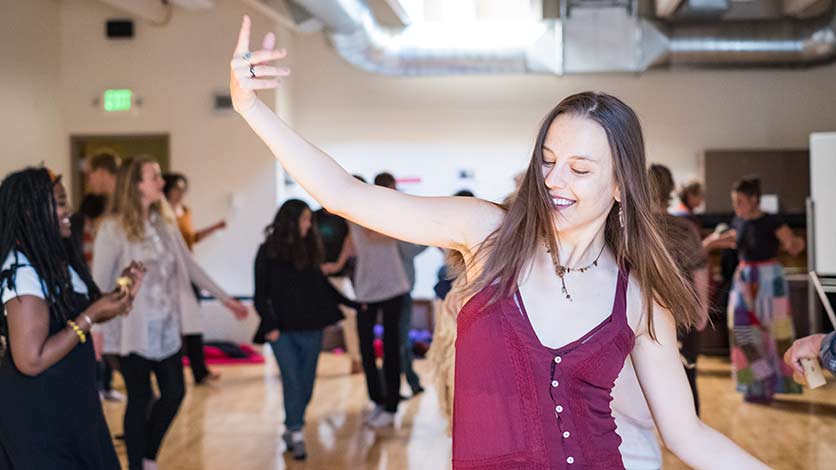
Body Movement Observation & Assessment
In this course, students begin to look at how the mind is expressed through the body. A range of observation and assessment models specific to somatic counseling is introduced, including kinesiological, morphological, developmental, energetic, segmented, process-oriented, and archetypal frameworks. Within the context of clinical application, this course focuses on movement observation and assessment as a collaborative endeavor between counselor and mover/client. The impact of sociocultural locations and identities as well as power dynamics are considered as they relate to observing and assessing movement.
Certificate
Requirements
Dance/Movement Theories & Practice Certificate Requirements
- CNSD-617 Foundations of Dance/Movement Therapy in Counseling (2)
An experiential and didactic introduction to the field of Dance/Movement Therapy in Counseling, including its historical roots and evolution; the contributions of major pioneers in the field; and the beginning exploration of various theoretical models and their implications for clinical practice, based on a commitment to diversity, service, and contemplative practice. Designed to introduce students to the diversity of the work of dance/movement therapists with both groups and individuals, and to begin to prepare students to facilitate dance/movement therapy with a wide range of clients. - CNSS-646 Contemplative Practice for Somatic Counseling (1)
This course will explore contemplative practices and processes from somatically based, social justice counseling perspectives. The course includes how to work with oneself from places of stillness and movement, and how this informs and supports one’s training as a body-based counselor. Class will consist of opportunities for practice for students to cultivate an ability to begin setting a contemplative container for future clients. - CNSD-716 Specialized Approaches in Dance/Movement Therapy in Counseling (2)
This course focuses on the relationship of Dance/Movement Therapy in Counseling to other creative arts modalities and is designed to offer students various methodologies for working with developmental and traumatic wounding. Readings, discussion, in-class experientials, out of class practice, and guest lecturers provide an overview of theory, techniques, and considerations for special populations. Emphasis is on the integration and application of creative modalities, and their application to specific populations. Prerequisite: CNSD 616 or 617. - CNSS-622 Body Movement Observation & Assessment (3)
In this course, students begin to look at how the mind is expressed through the body. A range of observation and assessment models specific to somatic counseling is introduced, including kinesiological, morphological, developmental, energetic, segmented, process-oriented, and archetypal frameworks. Within the context of clinical application, this course focuses on movement observation and assessment as a collaborative endeavor between counselor and mover/client. The impact of sociocultural locations and identities as well as power dynamics are considered as they relate to observing and assessing movement. - CNSS-606 Advanced Counseling Skills (3)
Through experiential and theoretical exercises, students learn how counselors apply somatically based counseling skills to advanced counseling theory. Developmental theory is explored through the lens of attachment theory and its implications for clinical practice. As an extension of these theories, the ethics, strategies, and practices for the use of touch in somatically oriented sessions will be introduced, as well as working somatically with developmental trauma. Students refine their skills in identifying and working with resistance and psychological defenses, develop greater facility in tracking transference and countertransference in the therapeutic relationship, and cultivate greater skill in applying theory-based clinical rationale for their therapeutic interventions. Furthermore, students hone their skills of guiding clients into therapeutic process, creating and maintaining a secure therapeutic container and therapeutic boundaries, as well as continuing to explore their own professional identity and boundaries as counselors. Prerequisites: CMHC-601, CMHC-604. - CNSS-665 Neuroscience of Crisis, Trauma & Disaster Response (3)
This course is designed to provide students with an understanding of the personal and systemic impact of crises, disasters, and other trauma-causing events on individuals, couples, families, and communities. Students examine theories and response models as they relate to sexual trauma, crisis in individuals and families, crisis in the community, and crisis in the nation and in the world. They explore and discuss topics related to counselor competencies, vicarious trauma and countertransference, specific diagnoses, and advocacy. Students also engage in assignments designed to provide practical application of crisis and trauma assessment. Through contemporary articles, books, case studies, and experiential activities they consider and discuss cultural, legal, and ethical issues related to crisis, trauma, and disaster events and response. - CNSD-621 Extended Practicum (1)
Prerequisite: CMHC 620. This course provides supervision for Dance/Movement Therapy students to complete their 200 hour practicum placement. Or for Body Psychotherapy students who need additional time to complete their 100 hour practicum placement, in the second year of their coursework. Students are supported in the application of counseling knowledge and skills, including methods unique to their concentration.
Meet the Dance/Movement Theories & Practice Faculty





Why Choose Naropa?
Contemplative Approach
Naropa’s curriculum emphasizes mindfulness and moving meditation as well as diversity and community engagement. Naropa’s Somatic Counseling programs will help transform you into a deeply aware therapist who is passionate about helping others create change in their bodies, minds, and lives, by first working with yourself.

Diversity & Inclusion
Naropa University is dedicated to embracing diversity and inclusive education. This is crucial for understanding and showcasing qualities that bring people together, aiming for a fair and united society.
Community-Based Learning
Through internship experiences, students become acquainted with different populations as they observe and participate in the community. This hands-on learning offers them the opportunity to act as professionals in training, gaining invaluable real-world experience and skills.

How this Program Prepares You
Clinical Experience
Your second year in the Dance/Movement Therapy program begins with supervision and mentoring during a 200-hour practicum. You’ll then begin your 700-hour internship journey in your third year, participating in collaborative team meetings and receiving clinical supervision as you lead dance therapy sessions and groups.
Movement Therapy Certification
Upon graduation, students in the dance/movement therapy concentration will have fulfilled the requirements for the American Dance Therapy Association’s initial registration as a Registered Dance Movement Therapist (R-DMT). Program graduates can apply for the R-DMT credential as soon as their degree is completed.
Diverse Learning
Graduate students in the dance therapy program gain a strong theoretical grounding in somatic movement therapy. Additionally, they engage in mindfulness practices and accumulate extensive clinical exposure. The ultimate goal is for each of our graduates to become self-aware, compassionate therapists who nurture mind-body synchronization.
Learning Outcomes
Critical Scholarship and Integration: Students will effectively research and write on Dance/Movement Therapy (DMT) and Body Psychotherapy (BP), integrating theory with clinical practice while demonstrating critical thinking and academic rigor.
Clinical Intervention Proficiency: Students will develop and apply effective counseling and DMT/BP interventions tailored to client needs, ensuring a compassionate and evidence-based approach in their therapeutic practice.
Professional Ethics and Standards: Students will adhere to professional ethics, self-regulate, accept supervision, and address power dynamics within therapy and institutional settings.
Cultural Competency and Pluralism: Students will embrace multicultural competency, recognizing and valuing diverse body experiences and movement patterns in their practice.
Embodied Awareness: Students will develop continuous awareness of their bodily sensations, emotions, and thoughts, enhancing their therapeutic presence.
Career Opportunities for Somatic Counseling: Dance/Movement Theories & Practice
Upon completing the master’s degree in somatic counseling: dance/movement therapy, our graduates pursue careers as individual and family therapists, program coordinators, dance therapists, and beyond. Regardless of your career path, the solid foundation from your clinical internship will empower you to serve with compassion and mindfulness.
- Dance Therapist: Employ dance movement therapy to improve well-being.
- Expressive Arts Therapist: Use art to aid emotional exploration and healing.
- Mental Health Counselor: Provide therapeutic support for emotional well-being.
- Substance Abuse Counselor: Aid in addiction recovery.
- Behavioral Disorder Counselor: Assist with behavioral challenges.
Hear from a Graduate
 The coursework at Naropa provided cutting-edge academic theories about the neurobiology of the mind as both embodied and relational and led me to feel exceptionally prepared when I later pursued my doctorate in clinical psychology.

FAQS about the
Dance/Movement Theories & Practice Certificate
Do I need formal dance training to study dance/movement therapy?
Yes, you need formal dance training to study dance/movement therapy. Applicants need expertise in at least two different dance (or movement) forms; in-depth and dedicated experience in a minimum of one dance form; and exposure to composition, choreography, performance, and dance history.
How is dance/movement therapy different from other forms of somatic healing?
Dance/movement therapy is different from other somatic healing forms by emphasizing movement and dance as core therapeutic tools. Unlike approaches focusing solely on touch or body awareness, Dance Movement Therapy uses expressive movement to address emotional, cognitive, and physical integration. Practitioners interpret nonverbal cues through dance, promoting self-awareness and emotional healing in a unique therapeutic context.
What makes Naropa’s Dance/Movement Therapy unique?
Naropa’s Dance/Movement Therapy stands out due to its integration of contemplative practices with therapeutic techniques. The program emphasizes a holistic approach, combining dance and movement therapy with mindfulness and self-awareness practices rooted in contemplative education.
Learn More About the Certificate Program

Connect with your counselor
Junia McGillen
Admissions Counselor
- Schedule a Meeting
- junia.mcgillen@naropa.edu
- (303) 276-6005


Connect with your counselor
Junia McGillen
Admissions Counselor

Ready to Apply?
Admission Requirements
At Naropa, we value both academic excellence and the willingness to carry out introspective work. Learn more about admission requirements and the application process for the Dance/Movement Theories & Practice Certificate Program.
Costs & Financial Aid
At Naropa, we believe quality education should be accessible. More than 75% of our graduate students receive some form of financial aid to help cover their costs. Our graduate costs & aid page covers costs and financial aid opportunities for graduate students, like scholarships, student employment, and loan options.
Graduate Scholarship Opportunities
Scholarships are a great way to help with the costs of going to school. Naropa University offers an array of scholarship opportunities to graduate students. Students may be eligible to receive scholarships by applying for scholarships or by being nominated for a scholarship. For more detailed information about the different scholarships available and how to receive them, please review our graduate scholarship page.

Interested in Dance/Movement Theories & Practice?
Read our blog or listen to our podcast!

Magazine
The latest episode of our podcast is available at Mindful U, Apple, Spotify, and Fireside now! In this episode, Heather Sutton, MA, LPC—somatic counselor, adaptive movement specialist, and chair of...

Mindful U Podcast 95. Valeria McCarroll, PhD: Somadelics, Pursuing Life with Psychedelic Support & Intentional Integration This episode of our podcast is available at Mindful U, Apple, Spotify, and Stitcher now! We are happy to have...

Magazine
Magazine