
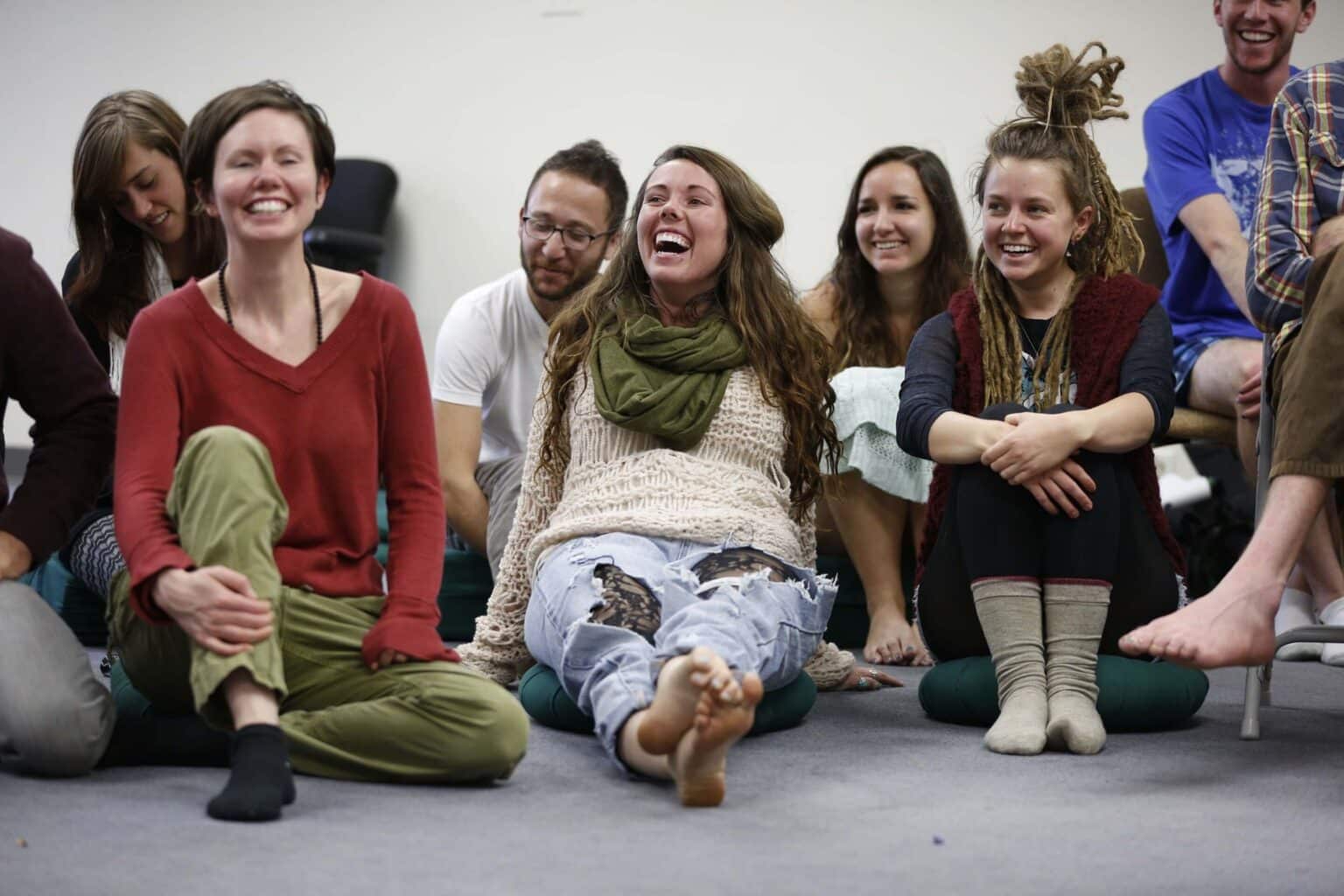

Naropa’s Bachelor of Arts in Psychology combines contemplative and mindfulness teachings from a variety of wisdom traditions with modern psychology and neuroscience in a program designed to equip you with the skills and compassion needed to confidently serve others.
If the question ‘’What can I do with a BA in psychology?’’ arises, this psychology school has different options for each student to find the right path, with concentrations in contemplative neuroscience, psychological science, psychology of health and healing, somatic psychology, and transpersonal and humanistic psychology.
Naropa’s Bachelor of Arts in Psychology will not only help you grow into your future career but grow and transform as a person as well.
The BA in Psychology program offers a wide array of diverse courses that integrate Western and Eastern approaches to healing the mind and body. Some of these courses include Perception, Cognitive Science, Abnormal Psychology, Dream Psychology, Hakomi, Nutrition, Psychology of the Five Elements, Expressive Arts, and many others.
The program focuses on contemplative education, consisting of genuine kindness toward oneself and gentleness toward others. You’ll also have practical opportunities for volunteer fieldwork in a required service-learning course. This fieldwork provides valuable experience for occupations that require special sensitivity and skill in interpersonal relationships.
You will study with accomplished and insightful faculty like Jordan Quaglia, PhD, and Jennifer Bacon, PhD. Dr. Quaglia conducts groundbreaking research on mindfulness, compassion, and lucidity. Dr. Bacon offers Naropa Bachelor of Arts in Psychology students a unique perspective on addressing issues of overrepresentation in special education, racial and gender equity, child advocacy, and writing for social justice.


Naropa University’s undergraduate program is a four-year, fully accredited BA degree program. The Bachelor of Arts in Psychology offers an innovative approach to the study and practice of psychology, guided by the principle that psychological health and well-being are innate.
The major is 38 credit hours: 29 credits from the psychology core requirements and 9 credits from one of the concentrations. The core requirements include courses in psychology and meditation, as well as courses in Western psychology.
Students pursuing a BA in Psychology can delve deeper into their studies by choosing from five concentrations: contemplative neuroscience, psychological science, psychology of health and healing, somatic psychology, or transpersonal and humanistic psychology.

This course introduces students to mindfulness-awareness meditation, blending Tibetan and Zen Buddhist traditions, and the teachings of sacred warriorship. By addressing the pitfalls of ego fixation, students cultivate inner calm, insight, and compassion. These practices equip them with tools to navigate personal and interpersonal challenges.
A Bachelor of Arts degree (120 credits) consists of a Core Curriculum (24 credits) and at least one major, as well as minors and/or elective courses of the student’s choosing.
The Bachelor of Arts in Psychology includes 38 credit hours.
PSYB101 Introduction to Psychology (3)
PSYB314 Psychology of Mindfulness Meditation (3)
PSYB301 Research Methods and Statistics (3)
Take twice for 2 credits:
PSYB343W Contemplative Community Retreat (1) OR
COL299 Special Topics workshops (1)
Choose one course from each set:
PSYB304 Somatic Intelligence (3)
PSYB329 Approaches to Healing (3)
PSYB354 Transpersonal Psychology (3)
PSYB359 Learning from Trauma (3)
PSYB345 Developmental Psychology (3)
PSYB357 Cognitive Science (3)
PSYB373 Social Psychology (3)
PSYB420 Abnormal Psychology (3)
Choose one of the following concentrations (9 credits):
*Special Topics courses (PSYB490 & PSYB495) may count towards your concentration when the content is in alignment. Approval needed from your advisor and program chair.
This concentration provides a foundation for integrating neuroscientific approaches into the study of the contemplative mind. Students’ development in this area joins training in cognitive neuroscience with meditative experience. Topics include important findings from functional brain imaging studies on embodiment, perception, emotion, consciousness, mind wandering, and contemplative experience beyond mindfulness. Students use contemplative practice as a laboratory for investigating their own mind and brain while employing a variety of complementary psychological research methods, including phenomenology, experimentation, task performance, and experience sampling.
PSYB301 Research Methods and Statistics (3)
PSYB462 Contemplative Neuroscience (3)
PSYB357 Cognitive Science (3)
PSYB368 Psychology & Neuroscience of Emotion (3)
The Psychological Science concentration emphasizes the study of human experience and activity through systematic observation. Topics include development from infancy through adulthood, individual differences, embodiment, perception, emotion, consciousness, thinking, social influence, self, and other aspects of mental life. In addition to theoretical study, methods of obtaining and evaluating empirical evidence are explored, ranging from behavior assessment to contemplative phenomenology.
PSYB234 Perception (3)
PSYB345 Developmental Psychology (3)
PSYB371 Personality Theories (3)
PSYB373 Social Psychology (3)
PSYB420 Abnormal Psychology (3)
The Psychology of Health and Healing concentration emphasizes body-mind synchronization as the key to inner harmony and well-being. Students explore a diversity of ancient and modern healing methodologies and learn experiential techniques for balancing the spiritual and somatic aspects of health.
PSYB329 Approaches to Healing (3)
Choose 6 credits:
PSYB208 Embodying Process and the Individual (3)
PSYB209 Herbal Medicine (3)
PSYB239 Nutrition (3)
PSYB303 The Psychology of the Five Elements I (3)
PSYB323 The Psychology of the Five Elements II (3)
PSYB333 Hakomi Somatics (3)
PSYB359 Learning from Trauma: Understanding Its Effects and Building Personal Resources (3)
The Somatic Psychology concentration emphasizes the practice of making meaningful connections between emotional process and the body’s expressions, sensations, and symptoms. Coursework includes three learning domains: 1) the historical and developing theory of body psychology; 2) the research and science regarding body psychology; and 3) the increase of body/self-awareness developed through experiential and movement-oriented classes.
PSYB304 Somatic Intelligence: The Neuroscience of Our Body-Mind Connection (3)
PSYB208 Embodying Process & the Individual (3)
PSYB255 Body-Mind Centering (3)
PSYB303 The Psychology of the Five Elements I (3)
PSYB328 Gestalt: Presence (3)
PSYB333 Hakomi Somatics (3)
The Transpersonal and Humanistic Psychology concentration helps students synthesize two major forces in Western psychotherapy and appreciate their unique contributions to the understanding of mental health. These include the recognition of spiritual longing for wholeness as essential to psychological growth and the acknowledgment of the importance of the client-therapist relationship in the healing process.
PSYB350 Humanistic Psychology (3)
PSYB354 Transpersonal Psychology (3)
PSYB225 Family Systems (3)
PSYB328 Gestalt: Presence (3)
PSYB330 Jungian Psychology (3)
PSYB355 Dynamics of Intimate Relationships (3)
PSYB430 Exploring Dream Psychology (3)
Students may elect to not have a thematic concentration. There are no required courses. Nine credits are to be selected from within PSYB.

Explore a short, self-paced course with sample classes, teachings from faculty, and real stories from students and alumnx about their experience. Get a feel for how learning happens here through reflection, practice, and real-world application.
Naropa's BA in Psychology offers chances for collaborative research with globally recognized faculty. As a leading institution in contemplative psychology in the Western context, Naropa is committed to exploring the impact of contemplative practices on both individuals and communities.

Your Bachelor of Arts in psychology culminates in a senior-year capstone experience: an exploration of Maitri Space Awareness, a community field placement focusing on social change, and a multidisciplinary senior project aimed at challenging both intellect and intuition.
Naropa offers scholarship opportunities for students admitted to the psychology degree who are enrolled full-time in at least 12 credit hours each semester, with awards determined by the student's cumulative GPA.

Learn from internationally recognized faculty in a psychology school that views learning as a journey. Naropa’s BA in psychology starts at the center of the individual with contemplative psychology and mindfulness practice before moving into traditional and psychological theories.
Naropa’s Bachelor of Arts in Psychology offers collaborative research opportunities with world-renowned faculty. Through these research opportunities, students contribute to advancing the global understanding of meditation and other phenomena associated with human consciousness.
In the final year of your psychology bachelor’s program, you’ll engage in a senior-year capstone experience. This includes delving into Maitri Space Awareness, participating in a community field placement with a focus on social change, and undertaking a multidisciplinary senior project designed to challenge both intellect and intuition.
Students understand and apply contemplative principles to Western psychological science.
Students enrich their approach to mind-body healing with peer-reviewed research.
Students work for social change and commit to diversity awareness in the community.
Step into a meaningful career that allows students to serve others.
Expand self-awareness to increase awareness of and compassion for others.
Graduates of the BA in psychology have sharpened their intellect, deepened their intuition, nourished compassion, and embodied confidence. These attributes form a crucial foundation for success in their careers. Some roles may require additional education, certification, or licensing.
Naropa’s program opens the door to meaningful careers with a BA in Psychology in fields like mental health, education, and social services.

Naropa offers an education that allows one to go within, then go out into the world. This allows space for spiritual growth and the understanding of what it means to be a compassionate person. This also allows space for one to understand one’s own pain and suffering. Being at Naropa is like an education retreat for me.
The difference between the BA (Bachelor of Arts) and the BS (Bachelor of Science) is the subject matter. The BA degree usually focuses on general studies and subjects like the arts, communication, and humanities, whereas the BS degree delves into subject areas such as science, math, and technology.
Naropa University’s undergraduate Psychology program is a four-year, fully accredited Bachelor of Arts degree program. The psychology major offers an innovative approach to the study and practice of psychology, guided by the principle that psychological health and well-being are innate.
A BA in Psychology can open doors to various entry-level positions in a variety of fields such as human resources, social services, marketing, and education. Careers with a BA in Psychology include a wide range of paths in mental health, education, and human services. Some roles—such as therapist, counselor, or psychologist—may require additional education, certification, or licensing. Potential career paths include mental health counselor, school psychologist, social worker, rehabilitation counselor, compliance manager, and more.
A Bachelor of Arts in Psychology is the first step toward becoming a therapist, but additional education, training, and licensure are required. A BA in Psychology prepares you for entry-level jobs in mental health and human services. To become a therapist, you typically need a master’s degree and must also complete supervised clinical hours and pass a licensing exam, depending on your country or state.


Admissions Counselor

Naropa University’s unique approach values both academic excellence and the willingness to carry out introspective work.
Learn more about admission requirements and the application process for prospective students.

Students with a 3.0 GPA or Higher
Applicants who can demonstrate a strong history of academic performance are welcome with minimal eligibility criteria.
Students with Less than 3.0 GPA
If you wish to benefit from a Naropa education and will contribute to our growing community, we strongly encourage you to submit your application, regardless of any past academic challenges.
Transfer your College Credit
You can transfer 60 or more transferable credits from previous studies by presenting an official college transcript on top of your application.
Read our admission requirements guide for first-time and transfer students to apply to Naropa.
We want everyone to have the opportunity to pursue an education at Naropa. Take a look at our page on undergraduate costs & aid to learn more about tuition, scholarships, grants, and financial assistance available at Naropa. You can also use our Net Price Calculator to have an approximation of your expenses at Naropa (currently based on 2025/2026 data).
Scholarships are a great way to help with the costs of going to school. Naropa University offers an array of scholarship opportunities to undergraduate students. Students may be eligible to receive scholarships through their admissions application (residential students only), by applying for scholarships, or by being nominated for a scholarship. For more detailed information about the different scholarships available and how to receive them, please review our undergraduate scholarship page.


The latest episode of our podcast is available at Mindful U, Apple, Spotify, and Fireside now! In this episode, Peter Grossenbacher, PhD—Naropa faculty member and psychological researcher—explores the science of...

Magazine

Magazine

What is mindfulness really doing to your mind? Jordan Quaglia, PhD, Director of Naropa’s Cognitive and Affective Science Lab, joins us to answer this and more on the science of...

By Odra William We recently got to sit down and video chat with one of our amazing alumnae, Emily Elrod-Black (BA Contemplative Psychology, ’15). We talked about the experiences that...


Mark Winwood, a member of the BA Psychology faculty at Naropa University in Boulder, is the founder of The Chenrezig Project, a Buddhist study/discussion group located in Northern Colorado, USA....
About Naropa
Located in Boulder, Colorado, Naropa University is a Buddhist-inspired, nonsectarian liberal arts university that is recognized as the birthplace of the mindfulness movement. Naropa offers undergraduate and graduate degree programs that emphasize professional and personal growth, intellectual development, and cultivating compassion.
Academics
Contemplative education brings together the best of Western scholarship and Eastern world wisdom traditions. Therefore, your pursuit of wisdom at Naropa means learning both about academic subjects and about your own place in the world. This innovative approach places Naropa on the cutting edge of the newest and most effective methods of teaching and learning.
Admissions & Aid
If you’re seeking an education that resonates with both personal fulfillment and global impact, Naropa could be your top choice. At Naropa, you will experience a comprehensive curriculum that integrates the best of Eastern and Western educational approaches. Explore how Naropa can fuel your journey of intellectual and spiritual development.
Life at Naropa
Through its incredibly vibrant and welcoming community, “Naropa offers a home for those who aren’t willing to conform to convention—the mystic, the healer, the prophet, the rebel, the artist, the revolutionary, the oddball—those who are incredible contributors to the evolution of society and of our planet.”—Core Associate Professor Zvi Ish-Shalom
The Naropa Difference
How is Naropa different from other universities? At Naropa, a liberal arts education balances rigorous academics with powerful interpersonal skills and self-awareness to educate the whole person. Naropa’s contemplative approach is inspired by Buddhist philosophy and the conviction that we can build a diverse, contemplative, enlightened society when we have transformed education to affirm the basic goodness of every person.
Support Naropa
At a time when the value of higher education is being questioned, Naropa University stands firmly rooted in its mission to create a more just and regenerative world by nurturing insight, awareness, courage, and compassion in its students. By making a gift to Naropa, you play a pivotal role in helping to create the authentic, effective & mindful leaders that the world desperately needs.


