

Stacie Moore
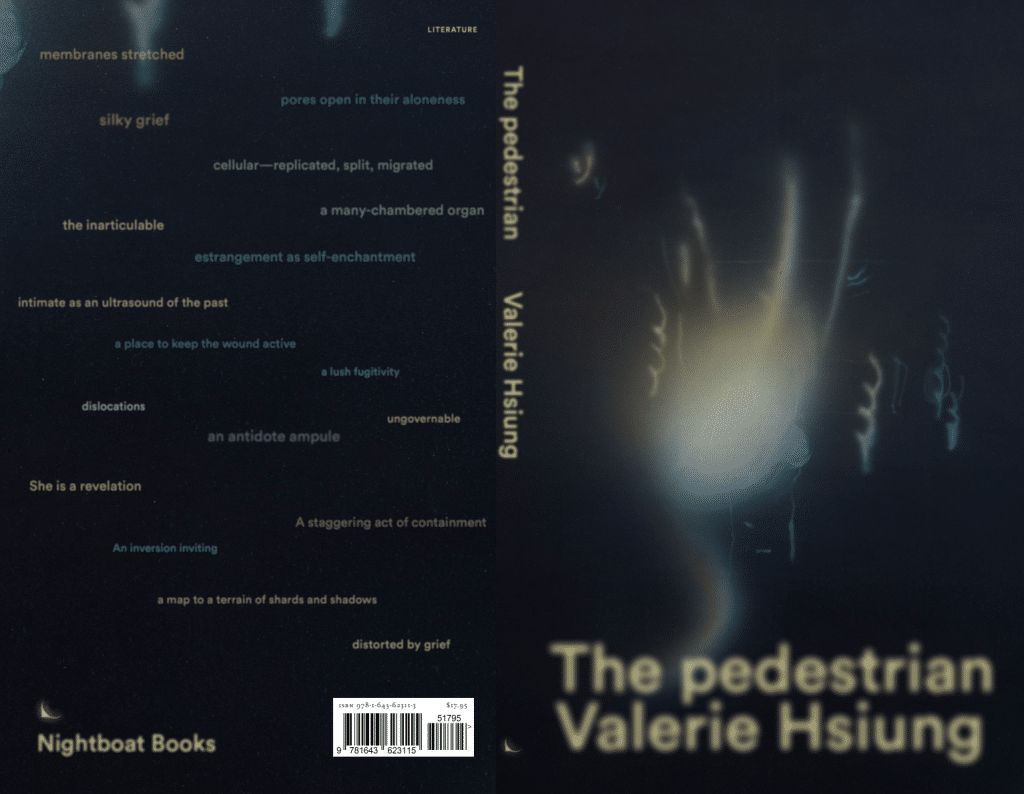
Bombay Gin Literary Journal’s poetry editor, Stacie Moore, had the delightful privilege of reading Valerie Hsiung’s The pedestrian prior to its release, and quickly thereafter sat down with the author to chat about it. We wholeheartedly recommend you read this stunning book to experience its depth, intelligence, and Hsiung’s unique ability to use language in unprecedented ways. This interview gives a glimpse behind the veil of the book’s and its author’s literary magic.
Pre-order your copy of The pedestrian online or look for it in a bookstore near you on July 7, 2026!
Stacie Moore: The perspective in this book is both magnifying glass and telescopic lens. There’s almost an eyewitness feel to portions of it.
Valerie Hsiung: So much of my childhood, maybe it was a particular Midwestern flavor, was deeply influenced by the cultural obsession with true crime. I was fascinated by that subgenre. Still to this day, if I’m having bouts of insomnia, I find myself reading unsolved mysteries. At the same time, I felt this sickness. It’s the sickness of our culture being obsessed with what stories are permitted in the cultural framework. And then what stories of lives lost, missing, are not culturally remembered? And that has always touched me in a horrifying way, like how horrifyingly sad that some lives are considered worthy of attention and others aren’t. And here I was, too, also obsessed with those stories that were given to me and seeking to uncover the ones that weren’t. They have to exist out there. Of course this book is not journalistic. It’s not a journalistic study of one genre or of these stories. But the word ‘eyewitness’ feels like a kind of query into what an anti-genre genre of writing can be, especially since some people have said: this is a biography, this is fiction, this is poetry! People have been trying to house it everywhere. And, sure, it belongs everywhere. And it belongs nowhere.
S: If people are trying to place it directly into one genre or another, they’re missing part of it. On page 11 you write, “There were things she saw in the first half of her life that she should never have repeated to anyone, but she would.” I’m curious if this book feels like this character—or you, it can be separate—doing that in a way? If so, does it feel like an exposure to the elements, still something that shouldn’t be happening? Or is it allowing it into the light?
V: I feel like that particular line and a lot of my writing, there’s a doubleness to them. The seed may have been a specific encounter, or a memory, but then as I’m writing it, I’m realizing I’m also creating a new encounter, a mythology. It exists almost always in these two places at the same time. A lot of my writing emerges out of this kind of impossible condition of being born in the wrong place at the wrong time. And it’s not just me, but anyone, that can feel this sense of deep alienation from their environments. I think often of children who might be a little lost in their environments, in their surroundings, not at home in their communities. There’s a negotiation between the secrets of their family, the secrets between where one comes from and where one is going, and the way everyday language can miss the mark in helping us move through this. It’s easier for the world to say we’re liars than to believe us. And when I say ‘us,’ I mean any poet, anyone who’s writing from this place between a direct encounter in the physical world as a misbelief and an indirect encounter as belief. It’s this impossible situation of being deeply and almost violently disconnected from your surroundings and at the same time feeling like you share a secret with the universe. That remainder which a poet can hold gives language almost unwillingly. In how time works in the book—it is moving forward and moving back often simultaneously, which speaks a bit to that impossibility, almost like being trapped in this position.
S: Part of the book talks about displacement, and as you said—wrong place/wrong time. The house in the book is almost its own character. Hypothetically, would the child’s ancestral land (where her mother was from) have been more of a home? Or would home always have been out of reach?
V: I think the only reason I, or any “I” or any “she” in the book, might have a conception of home comes from not having one or feeling so destabilized within a sense of home. I wonder if people who have never had to question what home is even have a conception of the poetry behind the very idea of home. And what I mean when I say poetry—I don’t mean the beauty of something. I mean the word itself carrying all this residue. Some of that residue is poisonous, and some of that residue can be enchanting, like dust over an heirloom that was passed down and you don’t even know where it came from anymore. It passed through so many hands and somehow it’s the only thing that survived. And so, if that voice or that psyche had never been displaced, the almost violent need to constantly try and try again to geolocate them would probably not exist either.
S: It’s probably not a question that has a straightforward answer, because how do you know if you don’t have that context?
V: Right. It’s possible for all kinds of people to inherit the sense of lostness with their home, whether it happened directly to them, whether it happened to someone as intimate to them as their mother or a friend. All of this can subtly change how we relate to the world, to language, but I do think that it would be so different. This arrival to English, or this need to own English, the forcefulness of the necessity, it’s a part of me, it’s what I have, and it’s also very different from what my mother had, who came to it when she was more integrally developed as an individual. It’s not just language or English that is my medium, you know, it’s the arrival to it, the need to own it even as it’s owning you. And so I can’t really speak to what it would be like to be in any other state.
S: With English being your medium, the review by Johanna Hedva mentioned that you use language in a way that “cannot be colonially extracted.” This also reads partially like prose poetry, and often (not always), effective poetry does not tell you everything directly. This book feels like an indirect confrontation of certain things. The writing has highly attuned peripheral vision. Can you talk about these approaches?
V: The first thing I’ll say is that it is both a blessing and a curse that I, even if I wanted to write a book that was just—A happened then B happened and then C—I couldn’t. I’ve tried and I can’t. Part of that probably has to do with the whole matrix of my displacement in the world that is part of my DNA. The various disabilities I carry. All these things probably impact that. So much of this book felt like I was writing as a channel. I was opening myself to and I was writing with the dead. And by dead, I mean yes, the actually dead, but I also mean those who might be alive but made dead by our world, by the political conditions of our world. In order to do that you have to approach something intentionally obliquely, you have to hollow yourself out. It’s a necessity. The aesthetic arises out of a political condition. The aesthetic form is a political necessity because otherwise it would be claiming: I am the sole author of this. By opening up, as you say, to the peripheral vision, suddenly it’s not just what’s visible right in the center. It allows a kind of open space for ghosts to walk in, for those who don’t have a home to dwell in, for those the writer doesn’t even know yet that they need to address. I don’t necessarily mean characters specifically, but voices, bodies, dreams, hopes, longings, all of that.
S: I can see that in the book. Sometimes there’s a more specific perspective and then sometimes you don’t know exactly what or whom is speaking, or you might have a sense of what’s speaking, but it’s not stated. I wrote a note on one of the pages, something like—”I am mistaking this house for my own.” It’s deeply affective, even without a concrete grasp of the perspective.
V: At the time I was working with this sense of—there is something so wild or unbroken about the way child-time and dream-time overlap. Both of those zones and the language that accompanies them are often the most permeable, right? That’s why childhood traumas can shape an entire existence. There’s some relation there to the only way to really allow the truth of it to come through is to almost forsake something else. And by doing so, it meant opening up the lens to the periphery.
S: When did you write this?
V: I started it on a November day. It was my first fall that I began teaching at Naropa, actually.
S: So, 2022?
V: 2022, yes. And I completed it the day before the summer solstice in 2023.
S: In the first forty pages or so, I wrote a note in the margin about Nod by Fanny Howe. You’ve talked about her influence on your writing. Did that influence this book directly, or were you not aware of it?
V: Oh, it almost certainly subconsciously influenced this book. I’m not sure how aware of it I was because I distinctly remember transcribing the first few pages in one go on one November evening, like a voice was coming to me from both afar and right underneath me… But Nod, like all of Fanny Howe’s work, rang like a bell for me – it was a language that I already spoke. But where I think Nod is crystalline and almost mathematical, The pedestrian stammers in a kind of helpless incantatory speculation. Bewilderment isn’t so much narrated in The pedestrian I think, as it is being metabolized. And that’s how many things that touch me deeply, that saturate my being, play out their half-life, I am of course, metabolizing them, at the same time that I am being metabolized by other half-lives that may not have been written or were never meant to be written.
S: There is almost no first-person perspective, other than in a bit of dialogue. I’m not saying it needs it, but would you ever tell a version of this story that incorporates that more?
V: Everything I write is a rewrite of something I already wrote. I’m writing the same thing over and over again just in another incarnation. And since finishing The pedestrian, I have written pieces that don’t quite lose the sideways-ness of that approach to language, but where the “I” can finally lay itself out on the page. I needed to write in third-person when I did, where I did, to find the tone that I needed at the time because that was the atmosphere of my life. I went to a reading recently and heard the poet Sueyeun Juliette Lee speak about the meaning of the word “incident,” and she said something that captivated me— an Incident being both the light that is reflected off of an object and a crime. It’s not that “I” doesn’t appear here because I didn’t allow it to, it’s more that it has something to do with the Incidence of it all. But as a writer, you finish something and that finishing frees you to see from another angle or to enter another portal in yourself, in the world. And so yes, I do think that it’s possible to tell this story again with “I” because ultimately we’re telling the same story, time and time again. We just find we’re shedding our skin and finding another way to perform that. But the I is never clean.
S: Yeah, I relate to feeling like I write the same thing over and over. A recent piece, Muck Wallow, was only titled that because I feel like I am wallowing in the muck of this subject and I can’t fucking get out of it. But when we’re writing about these things repeatedly it is because there’s still more to learn from it, there’s another perspective left.
V: It can be freeing as a writer too, to just say: You know what? These things follow me and they always will. I think ‘cure’ narratives are ridiculous. Because what you’re saying is oh, I wrote that, now I’m cured and I’m never going to have to worry. You’re promising something false, to others and to yourself, and not acknowledging it. No—you write something and that gives you a kind of power to hold something even as it’s holding you, of naming certain things in your life, even as they have named you, but the sickness doesn’t go away. It changes your ability to sit with it, so that it’s not as unbearable. And that practiced ability changes you and you can relate to it differently, but it’s still always a presence. It can sometimes even still be as intense, but at least there is a container for its intensity, so that you can look at it with more sustained attention. I kind of pity people who don’t have these constant hauntings because—how are they going to find a form for their soul?
S: Right? How do you anticipate people will respond to this book? Do you want it to be widely palatable?
V: I definitely don’t care for it to be widely palatable. Or even palatable at all. The poet Jen Bervin once said, I’m paraphrasing, “I don’t care if a lot of people read my work, but I care a lot if a small amount of people care deeply about my work.” For me, it’s much more important to have it reach the right people. I try not to anticipate how something will be received, and I think if I did, I wouldn’t write at all. Because I often feel like I’m writing into the void. Which is honestly very liberating. It can be kind of distraction for a writer to be aware of a commercial audience instead of the psychic audience of their writing, which should always be what matters.
S: I love that—psychic audience. Even if I’m not writing to a singular person, I often have a sense that I am writing to someone. And I think that’s what it is, the psychic audience.
V: Yes, exactly.
S: On page 25, you write, “for those who are coming outside again after being trapped somewhere for a long time.” I feel like that partially answers, at least in my interpretation, of who the book is for—part of that psychic audience.
V: Yes, there’s a sense of this tension between deep isolation, because you have to carve out this internal space to protect yourself from all the potential harms around you, and this sense of deep freedom. When you have lived through specific types of harm, it almost feels like you are able to walk through the world with this sense of—oh, everything’s happening for the first time. And as a writer, you need distance, from the street, to know what it means to be someone on the street, again.
S: Absolutely. Alright, last official question. You reference a first life & a second life in the book. What life do you think you’re on now?
V: A while back, I calculated what life it was that I was living… I’m trying to do the math right now. I will say, my astrological chart destines me to die and be reborn multiple times a day. By that logic, an infinite amount of transformations have happened in the course of our conversation. But if you were to map a person’s life in a linear fashion, I would say probably eight lives at this point. So, the answers are: infinite and eight. Eight flipped on its side is infinity. And though I’d like to say I’ve stopped dying, I also know that it’s what allows me to keep writing. And so as long as I keep dying, I will keep writing.
Stacie (they/she) is a writer & poet, strange human, cat parent—preoccupied with matters of love, grief, & collective liberation. Their first published poem appeared in Phil Lit in the fall of 2025, and won the Readers’ Choice Award. They are the 2025 Anne Waldman Fellow for the Jack Kerouac School of Disembodied Poetics, and serve as a Managing Editor for Bombay Gin Literary Journal.